


ICONICA · Editorial · September 2026
Cold Sweat
Do tattoos change the way you sweat? A small study said your ink cuts sweat in half. Then the follow-ups arrived. The truth is stranger, smaller and more useful than the headline.
Ten young men. One tattoo each, and only on one side of the body, so that the other side could serve as its own control. Two small gel discs, each soaked in pilocarpine, a drug that provokes sweat glands into action, pressed against the skin and coaxed inward with a faint electric current. Twenty minutes on the clock. Weigh the discs.
It is the same test hospitals run on newborns to screen for cystic fibrosis, and in 2017 Professor Maurie Luetkemeier and two undergraduates at Alma College, a small liberal arts school in Michigan, pointed it at a question nobody had bothered to ask properly: does a tattoo change how skin sweats?
The answer, published in Medicine & Science in Sports & Exercise, was emphatic. Tattooed skin produced roughly half the sweat of the bare skin opposite it. The sweat it did produce was almost twice as salty. All ten men sweated less from their inked side. The age of the tattoo made no difference. A five-year-old piece behaved like a five-month-old one.
The story went everywhere. Tattoos damage your sweat glands. Your ink is messing with your body's cooling system. Sports writers wondered aloud about the heavily tattooed athletes filling every locker room in the world. Fitness forums filled with people asking whether a sleeve was a heatstroke risk.
Nine years later, that study is still the one everybody quotes. It is also, on the question people actually care about, mostly wrong. And the reasons it is wrong turn out to be far more interesting than the headline ever was.
Why the claim was plausible in the first place
Nobody doubted the result because it made perfect anatomical sense.
Your skin holds somewhere between two and four million eccrine sweat glands. Each one is a tiny coiled tube buried in the dermis, with a duct that spirals up through the skin and opens at the surface as a pore. The coil makes the sweat. The duct carries it upward, and on the way it does something clever: it pulls most of the sodium back out of the fluid before it reaches the surface, so your body loses water without losing too much salt. That reabsorption runs through the same molecular channel that fails in cystic fibrosis, which is exactly why the newborn screening test measures sweat salt in the first place.
A tattoo needle punctures the skin thousands of times a minute and deposits ink in that same dermal neighbourhood. The ink is then caught and held in place by immune cells, permanently, in a process we covered in detail in The Science of Why Tattoos Are Permanent. The theory practically writes itself. Needles nick the ducts. Ink-laden immune cells and micro-scarring crowd the tissue around them. Damaged ducts can't reabsorb sodium properly, so the sweat comes out saltier. Damaged glands can't produce as much, so it comes out slower.
Luetkemeier himself likened the effect to what happens to sweat glands in severe burns. He was also, to his credit, the first person to urge caution. The pilocarpine test, he pointed out, is not how the body normally sweats. Real sweating is triggered by a rise in core temperature, not by a drug and an electric current. Whether the effect would survive contact with real life was an open question.
It did not take long to find out.
Then the follow-ups arrived
In 2019, a team at Griffith University on the Gold Coast, led by Ethan Rogers and Professor Ben Desbrow, took 22 tattooed people and made them exercise for twenty minutes in a temperate 25 degree room, collecting sweat from inked and bare skin as they went. The paper's title leaves nothing to interpretation: Tattoos do not affect exercise-induced localised sweat rate or sodium concentration. Not less sweat. Not saltier sweat. No difference at all.
Ollie Jay's Thermal Ergonomics Laboratory at the University of Sydney, one of the world's leading heat-stress research groups, published a short editorial the same year titled Do tattoos impair sweating? Their conclusion: the influence had probably been overestimated.
Luetkemeier's group came back in 2020 with a more realistic test. Instead of pilocarpine, they dressed five men and five women in tube-lined suits pumped with warm water until their core temperature rose a full degree, then measured how the skin responded. This time the tattooed skin sweated about 15 per cent less than bare skin, and it was slower to start. A real effect, but a fraction of the original figure, and one that emerged only under slow, passive heating in a laboratory.
The most thorough test came in 2022 from the Gatorade Sports Science Institute, who had a very practical reason to care. Sports scientists measure sweat sodium from small patches stuck to athletes' skin in order to build individual hydration plans, and they needed to know whether it was safe to put a patch on a tattoo. So they tested 33 recreational exercisers with 48 tattoos between them, ranging in age from three weeks to twenty years and in density from a few faint lines to solid blackwork, through an hour of cycling, running or gym sessions. Sweat rate, sodium, chloride, potassium: no difference between tattooed and bare skin on any of them. Two tiny footnotes survived the statistics. The youngest tattoos ran fractionally saltier, and the most colourful ones fractionally higher in chloride. Neither was large enough to matter to anyone.
By The Numbers
How much less tattooed skin sweats, study by study
Reduction in local sweat rate from tattooed skin versus adjacent bare skin. Luetkemeier et al., 2017 and 2020; Rogers et al., 2019; Baker et al., 2022. The two studies that used real exercise, the condition where sweating actually matters, found nothing.
A systematic review published this year rounded up the entire literature and reached the same place. Under real exercise, tattoos do not meaningfully change how much you sweat or what is in it.
How both sets of results can be true
This is the part worth understanding, because it explains why the original study was not a fraud and the follow-ups were not a cover-up.
The difference is flow. Exercise pushes sweat out of a gland at three to five times the rate of a pilocarpine disc or a warm-water suit. Picture a garden hose with a slight kink in it. Open the tap a quarter turn and the kink is a real bottleneck; you get a trickle where you should get a stream. Open it fully and the pressure simply blows through. The kink is still there. It just stops mattering.
The damage is probably real. It is overwhelmed by the one thing sweat is for.
That, in all likelihood, is what a tattoo does to the ducts beneath it. The micro-damage is probably real. Under the gentle, artificial stimulus of a laboratory test it shows up clearly. Under the one condition where sweating actually protects your life, which is hard work in heat, it is overwhelmed by sheer volume. Add the fact that even a full sleeve covers a small fraction of your total gland count, and the heatstroke headlines collapse entirely. Luetkemeier said as much in 2017, in the same press release the headlines were pulled from. It just did not make the cut.
The more interesting finding nobody reported
Buried in the dermatology literature, well away from the sports science, is a study that says something new about inked skin.
In 2021, dermatologists at the University of Granada measured 34 permanent tattoos against the bare skin beside them, not for sweat but for the basic physics of the skin itself: temperature, water loss, hydration of the outermost layer, redness, antioxidant capacity. They found that tattooed skin runs about half a degree cooler than untattooed skin. Its outer layer, the stratum corneum, holds measurably more water. And it responds differently to moisturiser than the skin next to it.
0.5°
Tattooed skin sits about half a degree cooler than the bare skin beside it, and holds more water at the surface.
A separate 2026 study of tattooed women found the skin barrier over a tattoo stays stable for at least a decade, but loses the natural variation from one body region to another that bare skin shows. Tattooed skin over a shoulder blade and tattooed skin over a wrist behave more like each other than their untattooed neighbours do.
None of this is alarming. All of it points to the same conclusion, the one we have built an entire section of this site around: tattooed skin is not decorated skin. It is remodelled tissue. It is permanently different, in ways that are subtle, measurable, and worth caring for on their own terms.
What this actually means for you
You will not overheat because of your ink
Not with a sleeve, not with a back piece, not with a bodysuit. Every study that tested real exercise found your cooling system works as designed. Train, race, sauna and sunbathe as you did before, with the usual caveats about sun that apply to everyone and doubly to anyone who values their ink. We cover that in our sunscreen guide.
The exception is the first two weeks
A fresh tattoo is an open wound, and sweat is salt water carrying whatever was living on your skin and your gym shirt. This is not about sweat glands; it is about wound care. Rinse a new tattoo promptly after any workout, never let a damp shirt sit on it, and follow the first 48 hours and showering guides to the letter. The heavy layer of ointment some studios still recommend is a separate problem, and one we tackled in Breathing Room.
Sweat does not fade tattoos
Ultraviolet light does, and so does friction, and so does an outer layer of skin that has been allowed to thicken and cloud over decades. Sweat is not on the list. If your ink looks duller after a summer of training, look at the sun, not the perspiration.
If you are an athlete, sweat testing on tattoos is fine
That was the whole point of the Gatorade study. Patches on inked skin give the same readings as patches on bare skin. Just avoid anything under a month old. For more on why elite sport became the most tattooed profession on earth, read Skin in the Game.
Tattooed skin holds water differently, so treat it differently
The Granada finding that inked skin hydrates and responds to moisturiser in its own way is the quiet argument for stage-specific care rather than whatever is in the bathroom cabinet. Skin that has been permanently remodelled deserves products formulated for what it has become, not for what it used to be.
The verdict
The study that went viral was right about something. Not what the headlines said, but something. The tattooed side of you is different tissue: measurably cooler, measurably wetter at the surface, and, at a laboratory trickle, a little stubborn about salt. In every practical sense, it is still entirely yours to sweat through.
Your tattoo is not slowing you down. Get back to it.
The best science on this question was done, appropriately enough, in Australia, on the Gold Coast and in Sydney, in rooms held at a temperature most of the world would call a pleasant spring day and most Australians would call mild. The verdict from both was the same. The ink stays. The sweat comes. Nothing about the one gets in the way of the other.
Frequently asked questions
Do tattoos affect sweating?
Under real exercise, no. Multiple studies between 2019 and 2022 found no difference in sweat rate or sweat sodium between tattooed and bare skin during training. Small reductions have only been measured under artificial, low-flow laboratory conditions.
Is it OK to sweat with a new tattoo?
Sweating itself will not harm a healing tattoo, but sweat is salty and carries bacteria, and a fresh tattoo is an open wound. For the first two weeks, rinse the tattoo gently and promptly after exercise and never leave damp clothing against it.
Does sweat fade tattoos?
No. Tattoo fading is driven by ultraviolet exposure, friction and the natural thickening of the outer skin over time. Sweat is not a cause.
Do tattoos affect body temperature?
Tattooed skin sits about half a degree cooler than bare skin at rest, according to a 2021 dermatology study, but there is no evidence tattoos affect your ability to regulate overall body temperature during heat or exercise.
Do heavily tattooed athletes overheat more easily?
No. Even the researchers behind the original 2017 study said tattoos were unlikely to impair cooling enough to matter during exercise, and every follow-up study under real exercise conditions has confirmed it.
The Complete System
A clinical, stage-targeted protocol engineered for the lifecycle of your ink.
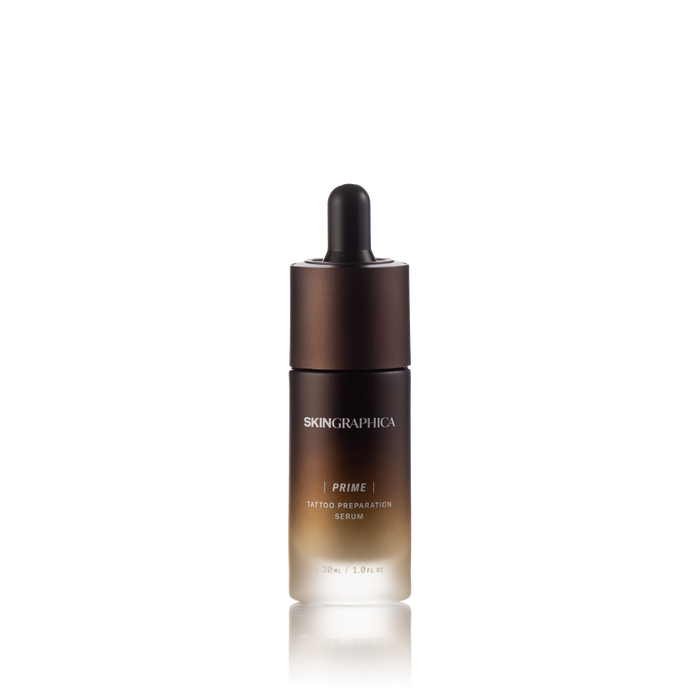
PRIME
Conditions and hydrates the canvas before the needle. Ceramide-rich for cleaner line work and smoother pigment saturation.
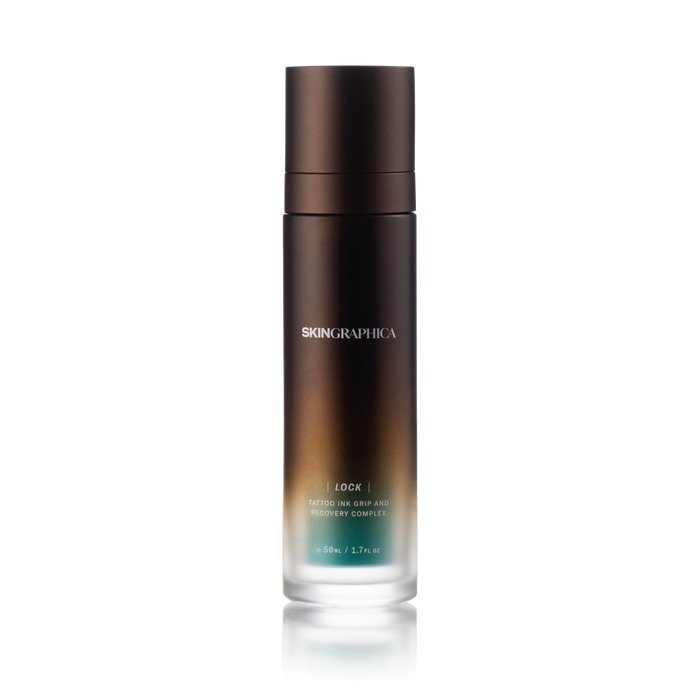
LOCK
A breathable recovery complex using Ink-Safe™ biochemistry to stabilise pigment and rebuild the barrier through the critical healing window.
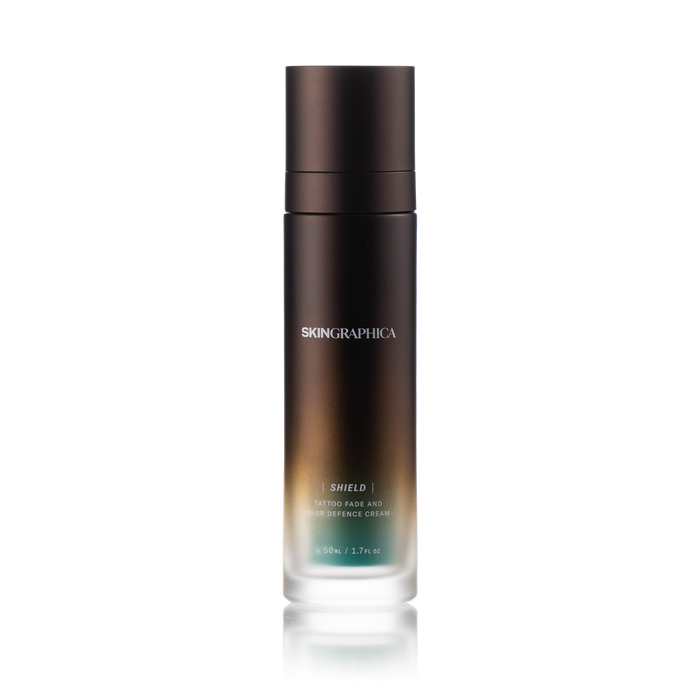
SHIELD
A transparent Fade and Blur Defence Cream. 360-degree shielding against UVA/UVB, HEV blue light, and urban pollutants with zero white cast.
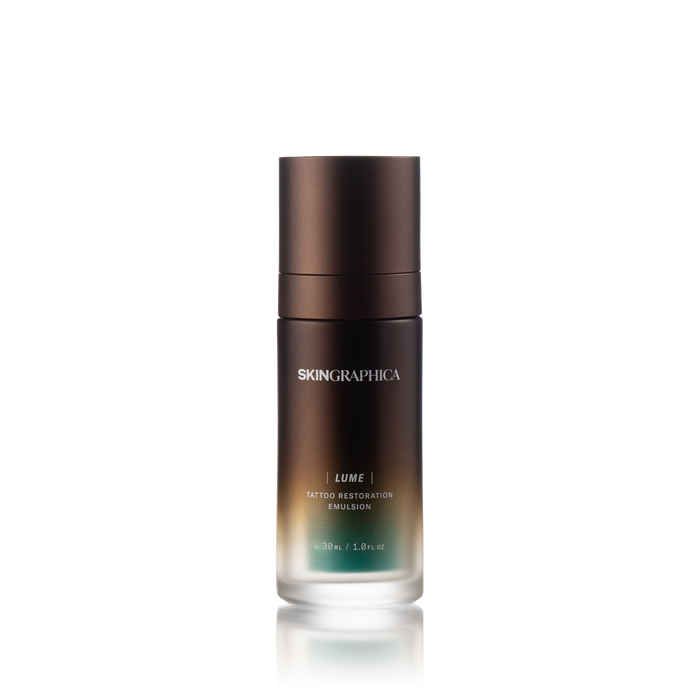
LUME
A world-first restoration emulsion, clinically engineered to revive the look of faded tattoos in as little as 10 days. Restores clarity, depth and dimensional lustre to older ink.


