

Skin in the Game
How body art moved from the margins to the main stage, and what the most visible people alive are saying when they wear it.
Stand near the front of almost any arena, stadium or runway today and you are looking at more ink than a tattoo convention would have drawn a generation ago. The guard bringing the ball up the floor, the singer holding the final note, the model who closes the show, the striker wheeling away after a goal. A great many of them are wearing their lives on the outside, in pigment chosen to outlast every contract they will ever sign.
This is a strange place for the tattoo to have ended up. For most of the last century in the West it was the mark of the outsider, worn by sailors, prisoners, bikers and carnival acts, and read by everyone else as a sign that a person sat somewhere beyond the velvet rope. Somehow the velvet rope moved. Today some of the most photographed, best paid and most closely watched people in the world are also among the most heavily tattooed, and the ink is no longer a confession of where they have been. It has become part of how they are known.
From the margins to the main stage
The shift shows up first in the ordinary population, well before any celebrity enters the frame. Roughly a third of American adults now have at least one tattoo, and among those aged thirty to forty-nine the figure climbs towards half. Women have moved ahead of men, and among women in their late teens and twenties more than half are inked. Four in five adults say the country has grown more accepting of tattoos over the past two decades, a rare point on which almost everyone agrees.
The General Picture
Share of US adults with at least one tattoo, by age
Pew Research Center, 2023. Across the wider population, 38% of women and 27% of men report at least one tattoo; among women aged 18 to 29 the figure reaches 56%.
So the famous are not lagging behind the culture, and they are not quite leading it either. They stand at the front of a parade the rest of the population had already joined, holding the most visible bodies in the world while they march. That visibility is the whole point. When your face and frame are your instrument, anything on the surface is amplified, and a tattoo on a person watched by millions does work that the same tattoo on the rest of us never could.
The arena
Nowhere is the gap between the famous body and the ordinary one wider than in elite sport. By one well known count, kept for years by a fan who logged every visible tattoo in professional basketball, roughly fifty-six per cent of NBA players carry ink, comfortably ahead of the general adult population.
The Elite Premium
Tattoo prevalence: the league versus the street
NBA figure from Ethan Swan's long-running tattoo tracking, reported by FiveThirtyEight; general population from Pew Research Center, 2023.
It was not always welcome. In the late 1990s the league worried openly that its most heavily tattooed young star, Allen Iverson, was bad for the brand, and dressed up that anxiety in the language of marketing. Within a decade the worry looked quaint. Ink became the default rather than the exception, and the conversation moved from whether players should have tattoos to what their tattoos meant.
What they tend to mean is achievement and memory. A debut, a championship, a record, the face of a mother or a brother who did not live to see the arena. The same instinct runs through football, where David Beckham turned his body into a running catalogue of his marriage, his children and his career, and made the heavily tattooed footballer ordinary in the process. Lionel Messi, Sergio Ramos and most of a modern Premier League dressing room followed his lead.
69%
of tattooed adults say honouring or remembering someone or something is a reason behind their ink, the single most common motive of all.
That figure explains a great deal about why the locker room reaches for the needle. A trophy can be lifted once and then handed back. A title can be lost the following season. The mark on the skin is the version of the moment that cannot be taken off the shelf, the body keeping its own score long after the record books have moved on.
The purest example of the form is not a club crest or a scoreline but five interlocking rings. The Olympic tattoo began with an American swimmer, Chris Jacobs, who came home from the 1988 Seoul Games and had the rings inked after noticing Canadian team mates wearing small flag tattoos. The habit spread from the pool deck across sports and across borders, until the rings became something close to a uniform among Olympians. Michael Phelps wears them on his hip, Adam Peaty and Tom Daley on the arm. Many competitors hold to an unwritten rule that you must have made the Games to earn them, which is exactly what gives the mark its weight. It is a membership badge for a club that no amount of money can buy a way into.
The medal can go in a drawer. The rings stay on the arm for life.
The oldest reason of all
None of this is new, and the word itself gives the secret away. Tattoo comes almost unchanged from the Polynesian tatau, carried back into English by the naturalist Joseph Banks, who sailed with Captain Cook and recorded the practice in the Pacific in 1769. Long before a swimmer thought of the rings, whole cultures had been building their most serious commitments directly into the skin.
In Samoa the tradition survives intact. The pe'a worn by men, running in dense black geometry from waist to knee, and the malu worn by women, are not decoration in any casual sense. They are applied by hand by a master tattooist over many painful sittings, witnessed by family, and understood as a contract of service to the community. To carry a finished pe'a is to have proven endurance and obligation. To abandon one half finished is a lasting shame. The mark is earned, and it cannot be given back.
That template, the commitment you suffer for and then keep for life, sits underneath the modern trophy tattoo more than most people realise. It is visible every weekend in rugby, where Samoan, Tongan, Māori and Fijian players carry Pacific designs through the ranks of the All Blacks, the Wallabies and the NRL. It reaches the cinema through figures like Dwayne Johnson, whose chest and arm carry a Polynesian composition tied to his Samoan heritage. Where the Olympic ring borrows the logic of the earned mark, the tatau is the source it borrows from.
The stage
Music had less distance to travel, because the performing body was always part of the act. A musician's skin is among the most photographed surfaces they own, lit and shot and printed across a whole career, and ink turns that surface into a diary written in public.
Amy Winehouse wore her pin-up tattoos as openly as her beehive, part of a persona assembled in plain sight. Rihanna keeps a collection that ranges from the barely there to the unmissable. Travis Barker is effectively a single continuous canvas. Harry Styles carries a scattered, deadpan set of small pieces that fans have catalogued line by line, and Ed Sheeran wears a deliberately scrappy patchwork he has cheerfully called a mess. Justin Bieber spent years turning his torso into one connected project, and Post Malone took the canvas all the way to his face, talking about the ink as a kind of armour over the parts of himself he was less sure of.
Across all of them the logic is the athlete's, run at a different tempo. Each tour, each record, each chapter leaves a mark, until the body reads as a timeline of the work.
The screen
Film has the most complicated relationship of the four, because the actor's body is meant to disappear into other people. For decades a visible tattoo was a problem to be solved with make-up and continuity notes, and many actors simply went without. That reticence has largely gone.
Angelina Jolie turned her body into something close to a map, carrying Khmer script and the geographic coordinates of her children's birthplaces. Jason Momoa wears a Hawaiian half-sleeve dedicated to his family and his aumakua, the shark that guards his line. Margot Robbie, the Australian, has collected a scatter of small tattoos from film sets, several of them administered by her own hand. Brad Pitt accumulates modest marks the way other people keep ticket stubs. Even in an industry built on transformation, the permanent mark survives as the one piece of the actor that belongs to the actor rather than the role.
The feed
Fashion arrived last and then moved fastest. For years a tattooed model was considered close to unbookable, the ink read as noise that competed with the clothes. Then the noise became the signature. Cara Delevingne made hand and finger tattoos a house style for a generation of models. Adwoa Aboah wears hers as part of an openly told story about her own life. Rick Genest, the artist known as Zombie Boy, walked for Mugler and appeared alongside Lady Gaga with his entire body tattooed, planting ink squarely in high fashion before his death in 2018.
The social economy took the idea and industrialised it. When a recognisable body is itself a brand, a distinctive tattoo becomes an asset, a logo a person carries everywhere at no extra cost. The tattoo artists became famous in their own right, from the television era of LA Ink to Instagram-native names like Dr Woo, whose waiting list runs to years and whose clients sit at the top of music and film. Somewhere in the move from prison yard to runway the signal inverted. The mark that once told the world you stood outside it now reads as authenticity and self-possession, which happen to be the exact currencies these platforms trade in.
Why them, why ink
Pull the threads together and three forces keep reappearing, each one sharpened in people who live in public.
The first is distinctiveness. Psychologists describe a basic human need for uniqueness, a drive to feel meaningfully different from the people around us, and appearance is one of the most direct places to satisfy it. Fame is built almost entirely on standing apart, so it is little surprise that the famous reach for one of the oldest tools for doing exactly that.
The second is story. Researchers who study identity talk about tattoos as a form of narrative, a way of writing the self into a fixed account while memory and circumstance keep shifting around it. One body of work describes a tattoo as an anchor for part of who you are during the long stretch when the rest is still being worked out. For people whose lives change at the speed of a transfer window or a release schedule, that anchor has obvious appeal.
The third is belonging. The Olympic rings and the Samoan pe'a are the same instinct at different temperatures, a way of declaring which group you have earned your way into. Teams, scenes and lineages all write themselves into the skin, and the marks let members recognise one another on sight.
There is one more force that belongs specifically to the famous, and it may be the strongest of all. A public figure controls almost nothing about their own image. It is styled, lit, shot, edited, cropped and sold by other people, often before the person has even seen it. The skin is the one surface they author for themselves, the single decision about their appearance that no manager, label or studio gets to overrule.
For people whose image belongs to everyone, the skin is the last thing they own outright.
Add the relationship that elite performers tend to have with pain and permanence, both of which a tattoo delivers in a small, voluntary and legible dose, and the pattern stops looking like fashion. It starts looking like something closer to need.
The shared thread
Across the arena, the stage, the screen and the feed, the move underneath is identical. These are people who have decided that the skin is a medium carrying meaning rather than a surface to be ignored, and who have committed that decision to the one canvas they can never swap out.
Which leads to a quieter point, and the one this magazine keeps returning to. If the skin is the medium, then looking after it is not vanity. It is maintenance of the work itself. A tattoo is only ever as good as the canvas that holds it. Line definition, colour depth, the clarity of a fine detail years down the line, all of it lives or dies in the health of the skin beneath.
That is the conviction SKINGRAPHICA® was built around. Not aftercare borrowed from the first-aid aisle, but a system designed for the full lifecycle of ink, from preparing the canvas to recovering it through the healing window, defending it against the things that fade it, and restoring colour that time has dulled. The most visible people in the world already treat their skin as their most valuable asset. The system below is for everyone who has reached the same conclusion.
The Complete System
A clinical, stage-targeted protocol engineered for the lifecycle of your ink.
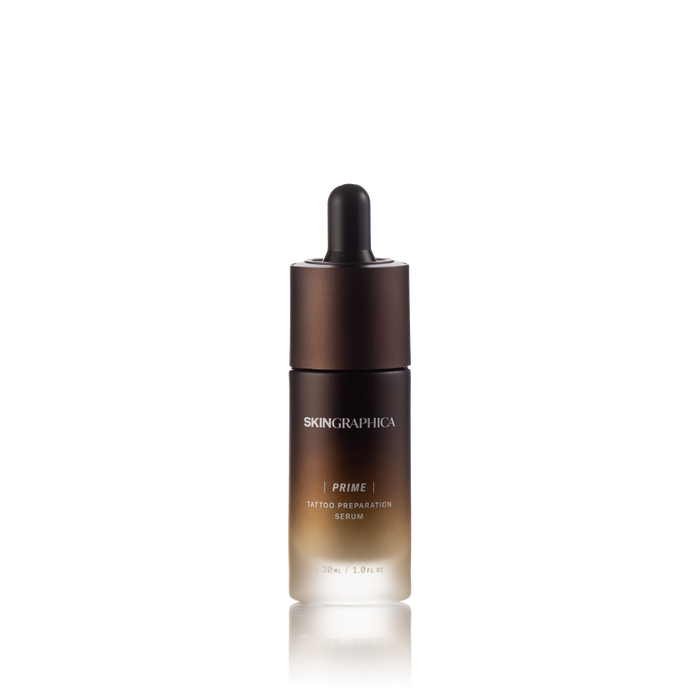
PRIME
Conditions and hydrates the canvas before the needle. Ceramide-rich for cleaner line work and smoother pigment saturation.
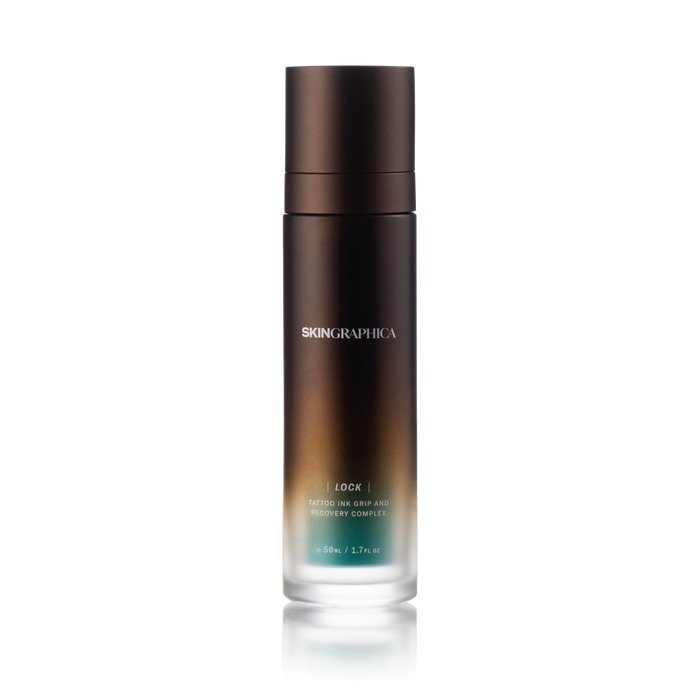
LOCK
A breathable recovery complex using Ink-Safe™ biochemistry to stabilise pigment and rebuild the barrier through the critical healing window.
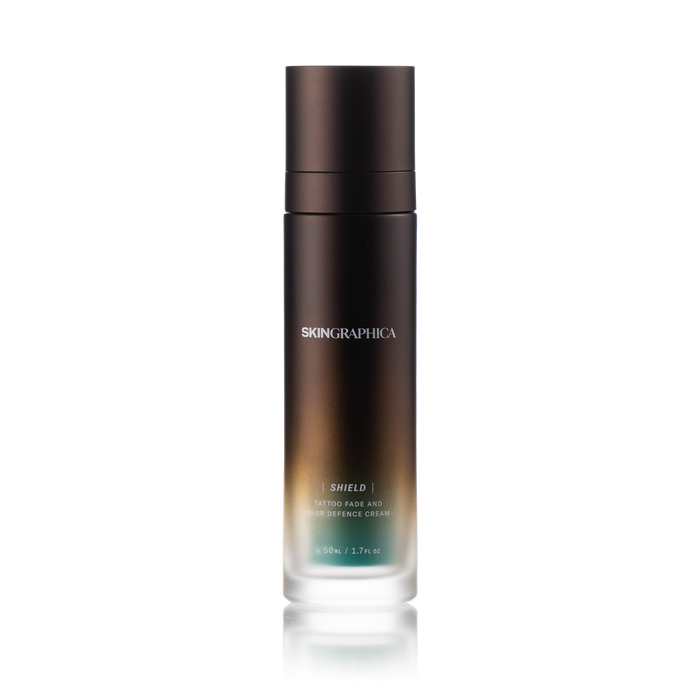
SHIELD
A transparent Fade and Blur Defence Cream. 360-degree shielding against UVA/UVB, HEV blue light, and urban pollutants with zero white cast.
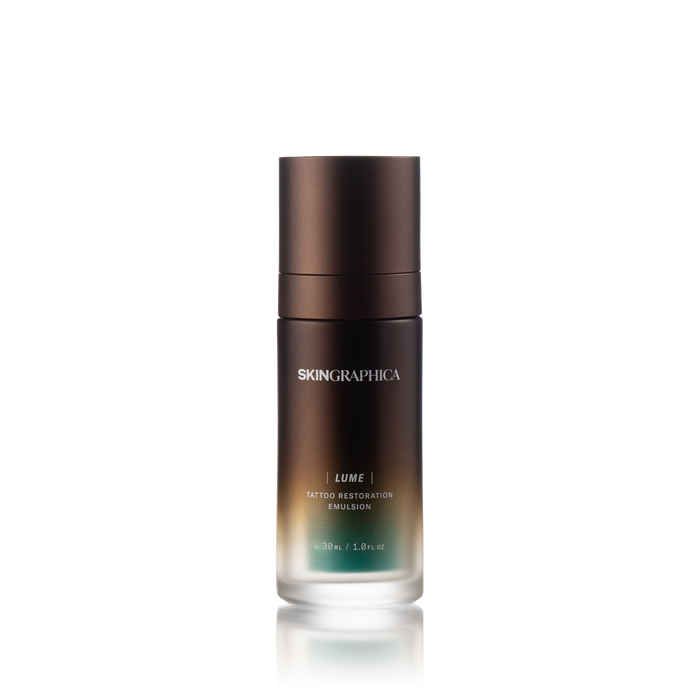
LUME
A world-first restoration emulsion, clinically engineered to revive the look of faded tattoos in as little as 10 days. Restores clarity, depth and dimensional lustre to older ink.


