

Breathing Room
Why smothering a fresh tattoo was always the wrong instinct.
Few rituals in modern life are followed as faithfully, or questioned as rarely, as the one that happens the night you get a new tattoo. You peel back the wrap, the skin is raw and shining, and you reach for the tub of thick clear jelly that someone, somewhere, told you to buy. You smear it on. It feels protective. It feels like care.
It is also one of the most quietly outdated habits in the business.
Nobody set out to put petroleum jelly on tattoos. It arrived there the way most old advice arrives anywhere, by being already on the shelf when the question came up. To understand why it persists, and why it deserves to be retired, it helps to know what the stuff actually does, and just as importantly, what it cannot.
Where the advice came from
Petroleum jelly was refined out of the oil fields in the nineteenth century and quickly became the default dressing for almost every minor injury a household could produce. Grazes, chapped lips, nappy rash, small burns. It was cheap, it lasted forever in the tin, and it was chemically inert, which in an era of harsh antiseptics counted as a genuine virtue. It did one job and did it reliably: it slowed the rate at which water escaped from the skin.
When tattooing moved from the margins into the mainstream, aftercare did not get designed so much as borrowed. A fresh tattoo looked enough like a graze that the same tin got reached for, and the habit set like concrete. The logic behind it was never really examined. It was simply inherited, passed from artist to client and client to friend, until the thick layer of grease became less a recommendation than a reflex.
What happens under the lid
The trouble is that a fresh tattoo is not a graze. It is a wide, shallow, deliberately inflicted wound, thousands of punctures spread across a continuous field of skin, weeping plasma for a day or two while the body mounts its response. That distinction matters enormously to anything you put on top.
Petroleum jelly is fully occlusive. It forms a seal that water vapour cannot cross at all. On a small, dry patch of skin that is a quiet virtue. Spread thickly over a large, warm, weeping area, it becomes something else. The heat, the sweat and the plasma have nowhere to go. The skin beneath stays soft, congested and, where the layer is heaviest, macerated. Pores and hair follicles clog under the film, which is exactly why heavy occlusion so often surfaces as a scatter of small bumps across an otherwise clean heal. The wound is not breathing. It is being held underwater and told that it is safe.
A seal was never the same thing as care.
Inert by design
Here is the part that rarely gets said out loud. Petroleum jelly does precisely one thing. It slows the loss of water from the skin, and that is the entire mechanism. It was engineered to do nothing else, and for more than a century its inertness was the whole selling point, because inert meant safe, predictable and impossible to get wrong.
A healing tattoo, though, is not asking for nothing. It is asking for a great deal, all at once. The barrier has been breached and needs rebuilding. Inflammation needs settling. The pigment, freshly lodged in the dermis, is being worked over by the immune system in the slow, cellular relay this series has described before. A film of grease answers none of these requests. It is present, but it does not participate. It sits on the surface keeping water in, while every demand that actually matters goes unmet beneath it.
Why the wrong mixture is worse than nothing
You might assume the obvious fix is simply to add the good ingredients back. The skin barrier is built from three lipids arranged in a precise order, ceramides, cholesterol and free fatty acids, the mortar packed between the cells of the outer layer. Surely, then, the answer is to put some of those lipids into the cream and let the skin help itself.
It turns out not to be that simple, and the science here is unusually blunt. When researchers applied just one or two of those lipids to damaged skin, recovery did not speed up. It slowed down. Only the complete set, supplied together in the correct proportion, allowed the barrier to repair at its normal rate, and a deliberately weighted ratio repaired it faster than the skin managed on its own. The lesson is an awkward one for the aftercare aisle. An incomplete or careless formulation is not a gentler version of the right one. It can be actively worse than reaching for nothing at all. Getting recovery right is not a question of adding nice ingredients. It is a question of architecture.
What recovery actually asks for
So the brief for a genuine recovery product more or less writes itself, and it looks nothing like a tub of jelly. It has to hold moisture inside the skin without sealing the surface shut, breathable rather than airtight, so that heat and fluid are never trapped against a weeping wound. It has to deliver the barrier lipids in the complete, correctly weighted form the skin can actually use, rather than a token gesture that does more harm than good. It has to calm the inflammation instead of ignoring it. And it has to manage all of this without disturbing the pigment as it settles into the dermis, a design constraint ordinary skincare never has to consider at all.
This is the gap a properly engineered recovery complex exists to fill, and it is the gap LOCK was built against. A breathable system in place of an occlusive lid, carrying the actives the healing window genuinely demands, tuned so that protecting the skin and protecting the ink become the same act rather than two that pull against each other. The distance between that and a smear of petroleum jelly is the distance between a tool chosen for the job and a tool that simply happened to be within reach.
Healing on purpose
An earlier piece in this series argued that a tattoo is less a mark you carry than a relationship you keep, maintained for you, cell by cell, by your own body for as long as you are alive to maintain it. If that is true, then the healing window is the single moment in that long relationship when the work is most exposed and most worth getting right.
The instinct to protect a new tattoo is sound. The reflex to reach for the heaviest, cheapest grease on the shelf and seal everything shut is the part worth letting go of. A wound that is being asked to heal does not want to be smothered. It wants the right conditions, supplied with intent, and then it largely wants to be left to do what it already knows how to do. Care, properly understood, is not the thickest layer you can manage. It is the most considered one.
The Complete System
A clinical, stage-targeted protocol engineered for the lifecycle of your ink.
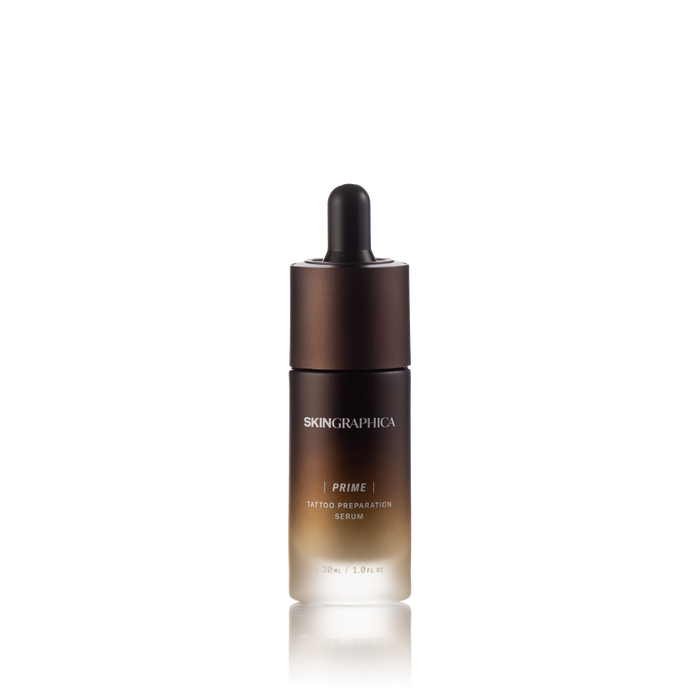
PRIME
Conditions and hydrates the canvas before the needle. Ceramide-rich for cleaner line work and smoother pigment saturation.
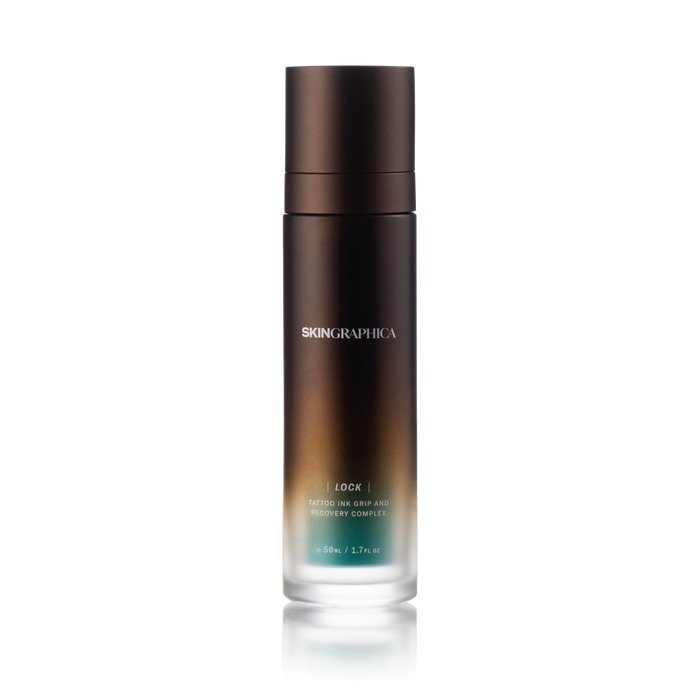
LOCK
A breathable recovery complex using Ink-Safe™ biochemistry to stabilise pigment and rebuild the barrier through the critical healing window.
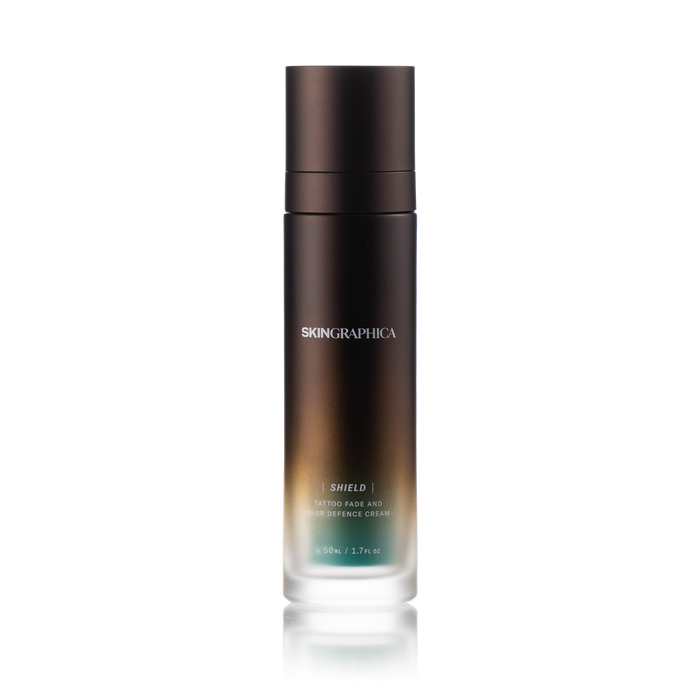
SHIELD
A transparent Fade and Blur Defence Cream. 360-degree shielding against UVA/UVB, HEV blue light, and urban pollutants with zero white cast.
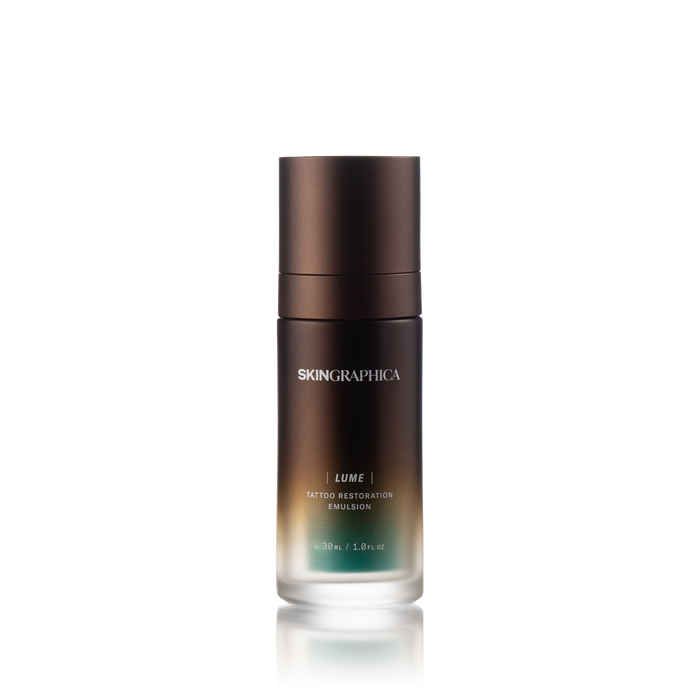
LUME
A world-first restoration emulsion, clinically engineered to revive the look of faded tattoos in as little as 10 days. Restores clarity, depth and dimensional lustre to older ink.


