


ICONICA · Editorial · September 2026
The Ozempic Tattoo
Millions of people are losing weight faster than their skin can follow. What happens to the art when the canvas shrinks, and how to protect it.
Tattoo artists have started describing the same appointment. A client comes back for a touch-up or a new piece, and the artist recognises the work on their body before they recognise the body. The sleeve is there but it no longer wraps. The script on the ribs has developed a ripple. The portrait on the upper arm has the faint slackness of a poster that has come away from its wall. The client has lost 25 or 30 kilos in under a year, usually on a drug whose name has become a verb, and the art has not kept up.
It has always been true that bodies change and tattoos change with them. Pregnancy, bodybuilding, bariatric surgery and ordinary ageing have all done this to ink for as long as ink has existed. What is new is scale and speed. GLP-1 medications have taken rapid, substantial weight loss from a medical rarity to a mass phenomenon, and they have done it inside the most tattooed generation in history. The collision was inevitable. Nobody planned for it.
The short version
- Ink sits in the dermis, anchored to the skin's collagen scaffold. It does not fade or move with weight loss. The skin around it does.
- Whether a tattoo survives intact depends on whether the skin contracts as the fat beneath it disappears. Speed of loss, age, genetics and sun history decide that.
- GLP-1 drugs produce loss of 15 to 20% of body weight in a year or so, and reviews link rapid GLP-1 weight loss to dermal thinning, loss of collagen and elastin, and redundant skin folds.
- Placement is destiny. Forearms, calves and upper backs barely move. Abdomens, flanks, inner arms and thighs move a lot.
- If you are losing weight, finish first and hold it. If it has already happened, wait for stability, then work with your artist. Folds cannot be lotioned away, but contrast can be restored.
The scale of it
In May 2024, a KFF tracking poll found that 12% of American adults had ever taken a GLP-1 drug and 6% were taking one at the time. By November 2025 the figures had doubled: 18% had ever taken one and 12% were currently on one, roughly 1 adult in 8. Among women the current-use figure was 15%. Among people in their 50s and early 60s it was 22%. Australia, the UK and Europe are following the same curve with a lag.
The drugs work. In the pivotal trial of semaglutide, the molecule sold as Ozempic and Wegovy, participants lost an average of 14.9% of their body weight over 68 weeks. Tirzepatide, sold as Mounjaro and Zepbound, produced average losses of over 20% at its highest dose in its own trial. For a 100-kilo person that is 15 to 21 kilos in about a year, and many people lose considerably more.
1 in 8 American adults were taking a GLP-1 drug in late 2025, double the share of 18 months earlier. The most tattooed generation in history is also the fastest-shrinking.
Set that against tattoo prevalence, which sits around a third of adults in the United States and Australia and above 40% for people under 40, and the arithmetic is simple. Millions of tattooed bodies are changing shape at a speed the industry has never had to deal with at volume.
What skin actually is
To understand what happens to a tattoo when the body shrinks, you have to stop thinking of skin as a surface and start thinking of it as a composite material with 3 layers that behave differently under load.
The epidermis on top is thin, replaces itself roughly monthly and carries no ink. Beneath it sits the dermis, a dense mat of collagen for strength and elastin for recoil, and this is where the pigment lives, held in place by immune cells that have swallowed it and cannot digest it. Beneath the dermis is the subcutaneous fat, and this is the layer GLP-1 drugs empty out. The tattoo is a drawing on a stretched canvas. The fat is the frame the canvas is stretched over. Take the frame away and what the canvas does next depends entirely on its own elasticity.
Young, undamaged dermis has enough elastin to contract as the fat beneath it shrinks, the way a rubber band returns to length. When that happens the tattoo simply gets smaller in proportion, and most people never notice. But elastin is a slow, expensive protein to make, its production declines from the 20s onward, and it is destroyed by ultraviolet light and by smoking. Collagen remodels on a timescale of months to years. Skin can keep pace with gradual change. It cannot keep pace with 20 kilos in 10 months.
A 2026 systematic review of 40 studies in Aesthetic Plastic Surgery catalogued what clinicians are seeing in GLP-1 patients: facial volume loss, dermal thinning, loss of collagen and elastin fibres, decreased skin elasticity, and localised fat loss leaving redundant skin folds across multiple regions of the body. Other reviews propose mechanisms beyond simple speed, including reduced protein intake, lower levels of growth and sex hormones during rapid loss, and a direct effect on the dermal fat that supports the skin from below. The science is young, but the clinical picture is consistent: the skin gets thinner and looser, and it gets that way fast.
The ink did not move. The body moved around it.
What happens to the tattoo
Three outcomes, in roughly descending order of frequency.
The first is proportional shrinkage. The skin contracts, the design contracts with it, and a piece that was 20 centimetres across is now 18. Lines get marginally closer together. Fine detail packs slightly tighter and can read as a touch darker. This is the best case and, for young people losing moderate amounts in stable areas, the usual one.
The second is drape. The skin does not fully contract, so there is more of it than the body beneath needs, and it folds. A tattoo on folded skin does what a printed image on folded fabric does: straight lines bend, curves flatten or double, and anything with a face or a geometric structure loses its logic first. Script and lettering are the least forgiving, because the eye knows exactly how a letter should look. Portraits are next. Organic, flowing work, botanical, Japanese, abstract, tolerates the distortion best because it has no straight lines to betray.
The third is the ghost of a previous gain. Skin that stretched quickly on the way up often tore in the dermis, leaving stretch marks. If those tears run through a tattoo, they show as pale streaks through the ink, and they become far more visible when the skin around them loosens. Nothing about the weight loss caused them; it revealed them.
What does not happen is fading. The pigment is exactly where it was and there is exactly as much of it. A distorted tattoo can look duller because slack, thinner skin scatters light differently and because folds cast shadows, but the ink has not gone anywhere. This matters for what can and cannot be fixed later.
A map of the body
Where a tattoo sits decides most of its fate. Skin over bone and lean muscle, with little fat beneath it, has almost nothing to lose and barely changes. Skin over the body's fat depots changes most. The map below is the one artists have used for decades for pregnancy and bodybuilding clients, and it applies unchanged.
Outer forearm and wrist
Most stable. Thin fat layer over bone and tendon. Fine line and script survive here.
Abdomen
Most volatile. The largest fat depot and the site of most post-loss redundancy. Avoid detail and text.
Calf, shin and ankle
Very stable. Calves change with muscle rather than fat, and slowly.
Flanks and lower back
Volatile. Skin here folds laterally as the waist narrows, distorting anything that wraps.
Upper back and shoulder blade
Stable. Broad, bony and lean. The safest large canvas on the body.
Inner upper arm and inner thigh
Volatile. Thin skin over fat with little structural support beneath. Drapes early.
Neck, hands and feet
Stable in shape, though hands and feet fade faster from sun and friction.
Chest and hips
Variable. Both carry fat and both change contour, more so in women.
The same story, told before
None of this is new to the trade. Around 8 in 10 pregnant women develop stretch marks, and artists have been advising on placement around the abdomen for as long as women have been tattooed. Bodybuilders have watched sleeves stretch across competition seasons and slacken in the off-season for decades. Bariatric surgery patients, who routinely lose 30 to 40% of their body weight, have been arriving at studios with draped and rippled work since the 1990s, and the body contouring surgeons who treat them have a whole literature on excess skin.
What GLP-1 drugs have done is take a phenomenon that used to arrive at a studio a few times a year and make it a weekly conversation. Some in the body modification world saw it coming; a widely shared 2024 piece by a body piercer urged the industry to research the drugs before the first affected client was lying on the table. Most studios are still working it out client by client.
If you are losing weight now
The single most useful thing you can do is tell your artist. Not because a GLP-1 changes how a tattoo heals, for which there is no evidence, but because it changes how the design should be planned. An artist who knows you are 15 kilos into a 30-kilo journey will place and size the work differently, or ask you to come back.
If the piece is large, detailed or anywhere on the map marked volatile, wait. Reach your goal and hold it for 6 to 12 months. Skin keeps contracting for many months after weight stabilises, and a design drawn for a body in transit is a design drawn for a body that will not exist. Small work in stable areas can go ahead whenever you like.
Choose forgiving designs for anything that will sit over a fat depot: organic forms, flowing composition, bold rather than fine, no lettering. And look after the material itself. Rapid loss is hard on skin, and the things that help it contract are unglamorous: adequate protein, no smoking, daily sun protection to spare what elastin you have, and consistent hydration and barrier care, the kind of preparation we describe in The Science of Skin Preparation. None of it reverses laxity. All of it improves the odds.
Doctors add one more: lose it slower if you can. Slower loss is the single variable most consistently associated with skin keeping pace, and it is a conversation worth having with whoever prescribes.
If it has already happened
Wait for stability first. Reworking a tattoo on skin that is still changing is throwing good ink after bad. Once your weight has held for the better part of a year, assess honestly, ideally with the artist who did the original work or one who specialises in reworks.
Mild distortion often needs nothing. Moderate distortion can frequently be reworked: lines re-established, elements added that use the new contours rather than fighting them, backgrounds extended to absorb the folds. Severe distortion on very loose skin is a cover-up or removal conversation, or a skin conversation first: radiofrequency and ultrasound tightening treatments help at the margins, and body contouring surgery removes redundant skin outright, along with any tattoo that happens to be on it.
Be clear about what care can and cannot do. Folds are a structural problem in the skin and no topical product will fix them. But the dulled look of older, slackened work is partly a surface problem, a clouded epidermis over pigment that is perfectly intact, and that part is recoverable. We covered the mechanism in The Science of Tattoo Restoration. Restoring contrast on a piece you have decided to keep is often the difference between living with it and hiding it.
Ozempic is one brand name for semaglutide, prescribed for type 2 diabetes; Wegovy, Mounjaro and Zepbound are the others most often used for weight management. This article uses the name the way the culture does, as shorthand for the whole class of GLP-1 medications. ICONICA is editorial, not medical advice. SKINGRAPHICA has no affiliation with any manufacturer.
The frame and the canvas
A tattoo is a fixed image on a living surface, and that has always been the bargain. The surface ages, weathers, stretches and slackens, and the image goes with it. What the last 3 years have changed is not the bargain but the tempo. Bodies that would once have changed over a decade now change in a year, and the art on them is asked to absorb a decade's worth of movement in a season.
The people who navigate this best will be the ones who treat their skin as the material it is: plan the work for the body they will have, not the one they have today; give the canvas time to settle before hanging anything on it; and protect what elasticity they have left. The ink, for its part, will do what ink has always done. It will stay exactly where it was put, and wait for the body to catch up.
Frequently asked questions
Does Ozempic ruin tattoos?
Not directly. There is no evidence the drug affects ink. What changes the tattoo is rapid weight loss: when fat under the skin disappears faster than the skin can contract, the skin folds and the tattoo folds with it. Slower loss, younger skin and stable placements minimise the effect.
What happens to a tattoo when you lose a lot of weight?
One of 3 things. If the skin contracts fully, the tattoo shrinks in proportion and looks the same, only smaller. If the skin cannot keep up, it loosens and the design ripples, drapes or bunches. If the weight was gained fast in the first place, old stretch marks may show as pale lines through the ink.
Should I wait to get a tattoo until after I lose weight?
For large or detailed pieces in volatile areas, yes. Most artists suggest reaching your goal and holding it for 6 to 12 months so the skin can settle. For small pieces in stable areas such as the forearm, wrist, calf or upper back, there is little reason to wait.
Can a tattoo distorted by weight loss be fixed?
Often, once your weight is stable. Options range from reworking lines and adding elements that use the new contours, to a cover-up, to laser removal. Skin-tightening treatments or surgery address the skin rather than the ink. Faded contrast in older work can be restored; folds cannot be lotioned away.
Which tattoo placements change least with weight?
Outer forearm, wrist, hand, calf, shin, ankle, upper back and shoulder blade, and neck. The areas that move most are the abdomen, flanks and lower back, inner upper arm, inner thigh, chest and hips.
The Complete System
A clinical, stage-targeted protocol engineered for the lifecycle of your ink.
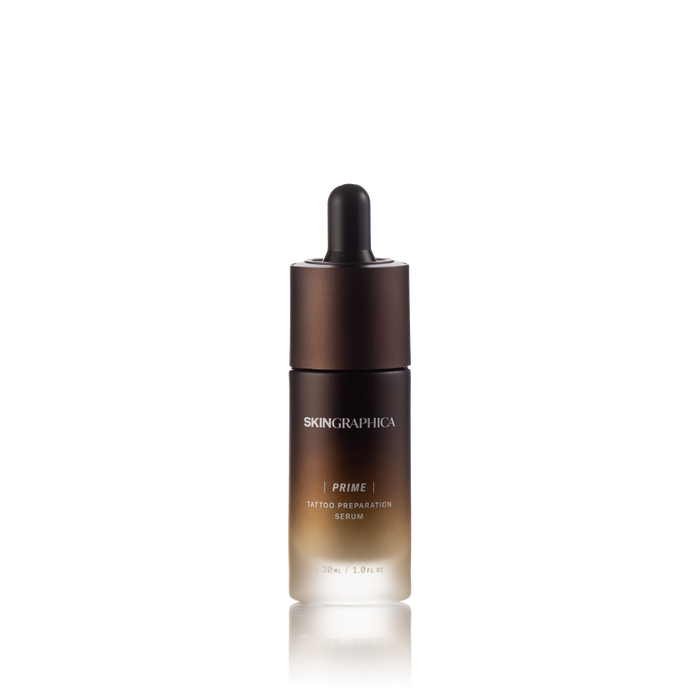
프라임
Conditions and hydrates the canvas before the needle. Ceramide-rich for cleaner line work and smoother pigment saturation.
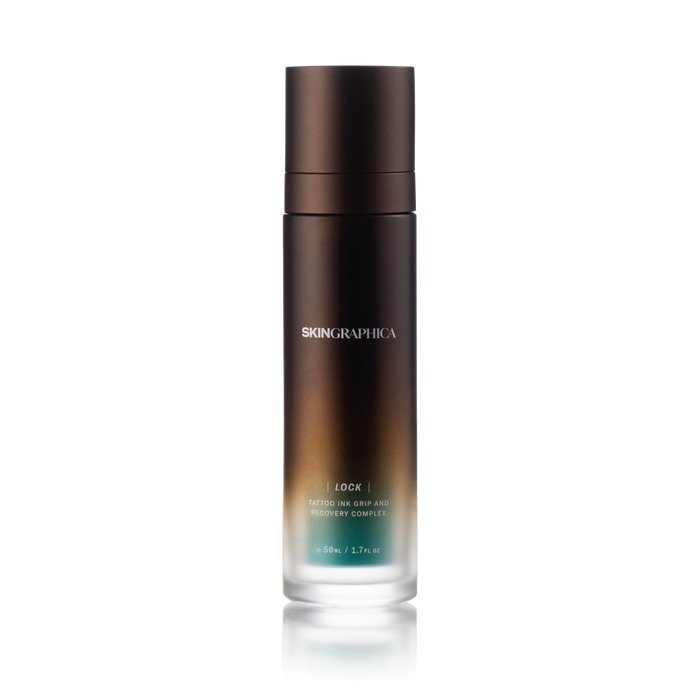
잠금
A breathable recovery complex using Ink-Safe™ biochemistry to stabilise pigment and rebuild the barrier through the critical healing window.
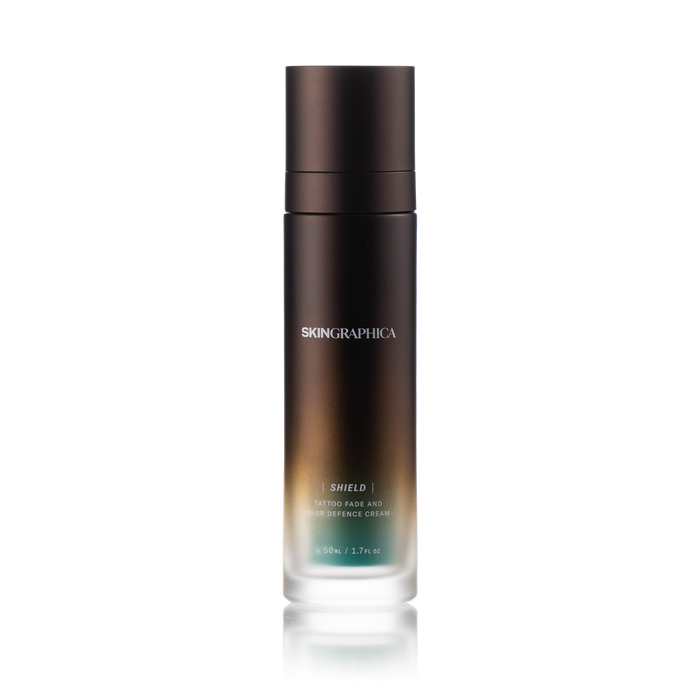
방패
A transparent Fade and Blur Defence Cream. 360-degree shielding against UVA/UVB, HEV blue light, and urban pollutants with zero white cast.
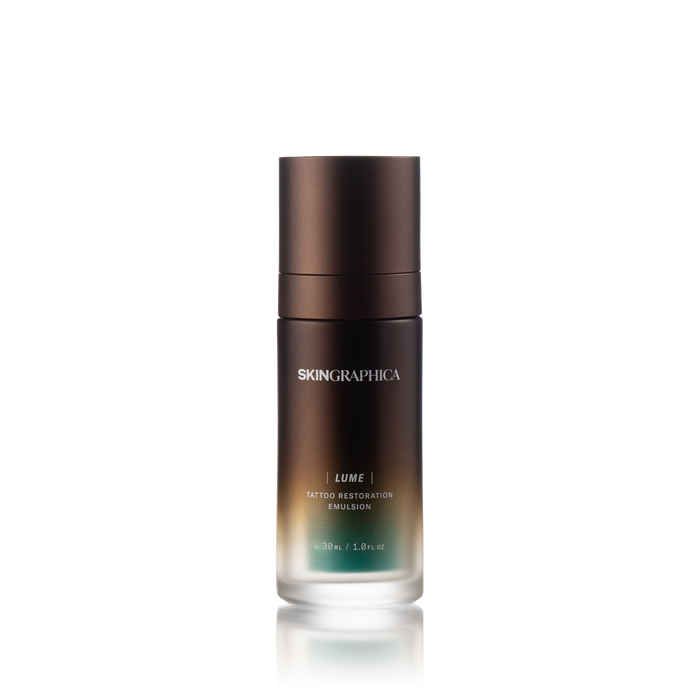
루메
A world-first restoration emulsion, clinically engineered to revive the look of faded tattoos in as little as 10 days. Restores clarity, depth and dimensional lustre to older ink.


