

Total Coverage
Meet the people who ran out of skin, and what drove them all the way to the last inch of it.
There is a small and strange fellowship of people who have done what almost no one else has even attempted. They have run out of skin. Not figuratively, not nearly, but completely: every shoulder and shin and eyelid spoken for, the body filled to its edges and, in one case, filled again on top of itself. To look at them is to confront a question most of us never think to ask. How much of a person can a tattoo become before there is no person left uncovered, only the work?
The honest answer is that the limit arrives sooner than the wanting does. An adult body carries only so much surface, and the people who have reached its boundary form a kind of accidental club, scattered across a century and joined by almost nothing except the decision to keep going until there was nowhere left to go.
The finite canvas
Skin is generous, but it is not infinite. Spread flat, the skin of an average adult covers roughly two square metres, and that figure is the wall every coverage record eventually runs into. You can tattoo a back, a chest, a pair of full sleeves, both legs, the scalp and the face, and still the arithmetic holds. There is a last bare patch, and then there is none.
2m²
roughly the total skin surface of an adult body, the fixed canvas every coverage record eventually runs out of.
This is what makes the most heavily tattooed people genuinely unusual rather than merely committed. The frontier they reached is the same for all of us, the identical two square metres whether you are a duchess or a sword swallower, and only a handful have ever pressed all the way up against it. Their stories, it turns out, share almost nothing but the destination.
The oldest spectacle
The first of them did it for a living. In 1920s London a former army major named Horace Ridler walked into the studio of George Burchett, the most celebrated tattooist of the age and a man who had inked European royalty, and asked to be covered head to foot, face included, in bold curving stripes of his own design. Burchett hesitated, worried the facial work would turn his client into an outcast, then agreed in writing and spent the better part of seven years on the task, some hundred and fifty hours under the needle.
Ridler became The Great Omi, the Zebra Man, and for a while one of the highest paid sideshow performers in the world. He headlined Robert Ripley's Believe It or Not, appearing more than a thousand times in a single six-month run, and toured Britain, Europe, America, Australia and New Zealand. To thicken the act he invented a lurid origin, claiming he had been captured and forcibly tattooed by tribesmen in New Guinea, a fiction his audiences had no way to check. The whole elaborate creature was a business, built deliberately to be looked at and paid for. And yet near the end of his life the man who had made himself into a spectacle insisted that underneath it all he was perfectly ordinary.
The leopard and the hermit
If Omi is the genre's origin, Tom Leppard is its most disarming honesty. A former soldier of nearly three decades' service, he set out, in his own cold-blooded telling, to become the most tattooed man in the world, and chose a leopard pattern for the plain reason that spots were the easiest thing to repeat across an entire body. He felt no kinship with the animal. The saffron-yellow skin between the dark rosettes covered close to the whole of him, an estimated ninety-nine per cent, and it was, he said flatly, a necessary evil to top up his pension rather than anything he enjoyed.
What he did with the result is the strange part. Leppard moved to the Isle of Skye and spent some twenty years as a hermit in a roofless old bothy by a sea loch, with no power and no plumbing, kayaking to the mainland once a week for supplies and his pension. The most visually extreme man in Britain had made himself almost impossible to see. He held the record until an Australian overtook him, was later recognised instead as the most tattooed senior citizen, and died in 2016 at eighty, still answering to the Leopard Man of Skye.
Skin runs out long before the wanting to fill it does.
The illustrated lady
Not everyone chose the frontier. Some were driven to it. In her mid thirties an American woman named Julia Gnuse developed porphyria, a condition in which sunlight blisters the skin and the blisters heal into scars as deep as third-degree burns. A plastic surgeon friend suggested tattooing the damaged areas in a flesh tone to disguise them. The colour never matched, so Gnuse changed direction entirely and began covering the scars with vivid, deliberate art: jungle scenes, cartoons, the faces of actors she admired, a portrait of herself.
The ink did nothing to stop the blistering, which was never the point. It hid the aftermath and, somewhere in the process, became something she owned rather than something inflicted on her. By the time she had finished, roughly ninety-five per cent of her body, her face included, was tattooed, and she held the Guinness record as the most tattooed woman in the world. She had taken a disease that was rewriting her skin without permission and answered it by rewriting the skin herself, on her own terms.
Running out of skin
The current record belongs to a New Zealand performer of Aboriginal Australian heritage, born Gregory Paul McLaren and known the world over as Lucky Diamond Rich. He is the man who took the arithmetic to its logical end. First he wore a full suit of colourful tattoos drawn from every tradition he could find. Then, not finished, he had the entire surface blacked out in solid ink, down to his eyelids, his gums, the webbing between his toes and up into his ear canals. Then, still not finished, he began having white designs tattooed back over the black.
1,000+
hours Lucky Diamond Rich has spent under the needle, more than forty days of tattooing across hundreds of artists.
By his own reckoning he is past two hundred per cent coverage, layers stacked three and four deep in places, which is why he prefers to say he has no collection of tattoos at all. He has one, he says, the largest on the planet, and it happens to be himself. He has spoken about the work in a way none of the old showmen ever would: that he had to tattoo his whole body before he could like himself as much as he now does. Off the stage, today, he works as a support worker helping Aboriginal men through alcohol and drug recovery, an ordinary and useful life lived under the most extraordinary skin in the world.
Two of a kind
Where Leppard chose solitude and Lucky went alone to the limit, Charlotte Guttenberg and Chuck Helmke reached it together. The American couple took up serious tattooing later in life and kept going until Guinness recognised them as the most tattooed senior woman and man, her body close to ninety-nine per cent covered, his a little behind. They were inked side by side over years, each design a shared decision, until the commitment they had made to one another was legible on almost every inch of both of them. It is the warmest version of the story, two people writing the same chapter onto two bodies at once.
The Field, Measured
Documented body coverage of the record-holders
Documented coverage per Guinness World Records. Lucky Diamond Rich passes 100% through layered tattooing, ink applied over ink; the others sit just beneath the natural ceiling of the skin.
Why go all the way
Line the cast up and what is striking is how little their reasons resemble one another. Omi and Leppard did it for money and the stage, one with theatrical relish and the other with weary candour. Gnuse did it to reclaim a body that illness had begun to take from her. Lucky did it to arrive, eventually, at a version of himself he could live inside. Guttenberg and Helmke did it for each other. Different motives entirely, leading the same five people to the same place.
The thread that does run through all of them is the oldest reason anyone gets a tattoo, pushed to its furthest point: the urge to make the body unmistakably one's own. Psychologists describe a basic drive towards uniqueness, a wish to feel distinct from everyone around us, and there is no more total way to satisfy it than to leave no surface unclaimed. At full coverage the skin stops being something you were merely born with and becomes something you authored in full.
And then there is the quiet refrain that keeps surfacing whenever these people are asked about themselves. The Great Omi, near the end, said he was just an ordinary man. Lucky Diamond Rich, decades later, says almost the same thing: that he bleeds like anyone, worries like anyone, is no different from anyone, only more heavily tattooed. The spectacle lives entirely on the outside. Within it, by every account they give, sits a person much like the rest of us.
All that spectacle, and an ordinary person underneath.
The whole canvas, kept
There is a practical footnote to all of this, and it is one this magazine takes seriously. The people who cover every inch are also the people with the most to lose to time. When ninety-five or a hundred per cent of you is ink, fading is not a local problem confined to one small piece. It is total. Sun, friction and neglect do not blur a single design, they dull the entire person, and there is no clear skin left to set the worn work against.
That makes the fully tattooed, in a sense, the ultimate argument for looking after the canvas. A tattoo lives or dies in the skin that holds it, and the more of yourself you have committed to the needle, the more the health of that skin becomes the health of the whole image. It is the principle SKINGRAPHICA® was built on, taken to its extreme: a system made for the full life of ink, from preparing the skin to recovering it, defending it against the things that fade it, and restoring colour that time has worn down. Most of us will never run out of skin. The case for treating what we have as worth keeping is exactly the same.
The Complete System
A clinical, stage-targeted protocol engineered for the lifecycle of your ink.
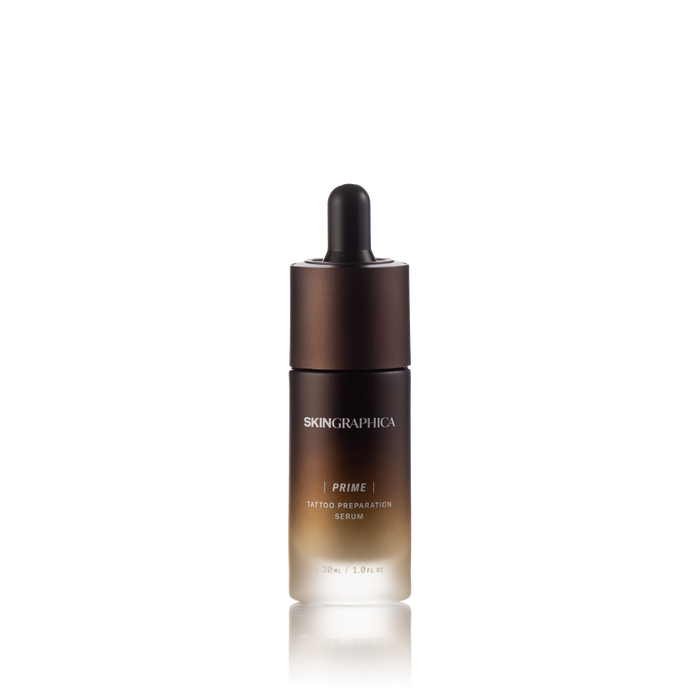
PRIME
Conditions and hydrates the canvas before the needle. Ceramide-rich for cleaner line work and smoother pigment saturation.
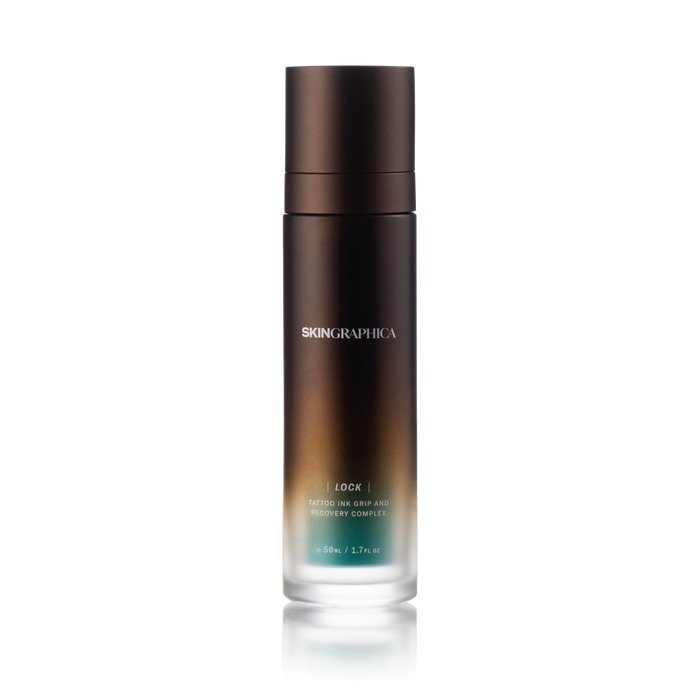
LOCK
A breathable recovery complex using Ink-Safe™ biochemistry to stabilise pigment and rebuild the barrier through the critical healing window.
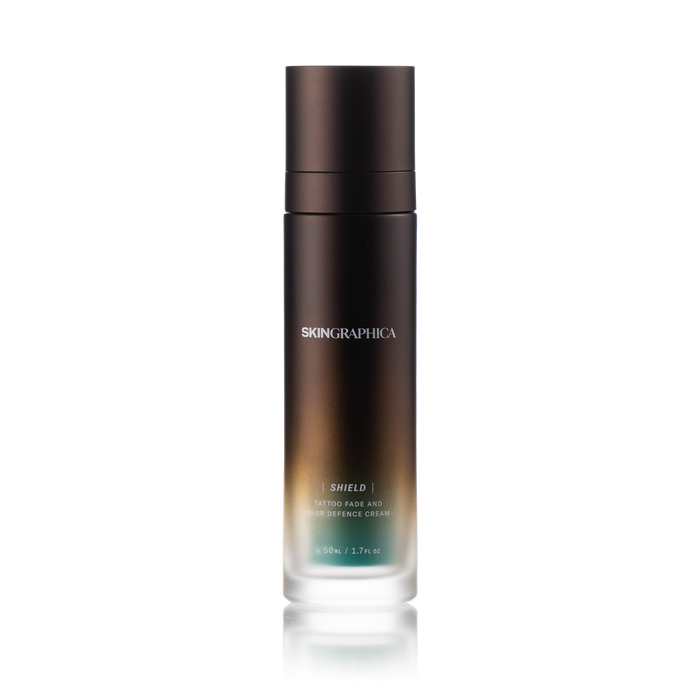
SHIELD
A transparent Fade and Blur Defence Cream. 360-degree shielding against UVA/UVB, HEV blue light, and urban pollutants with zero white cast.
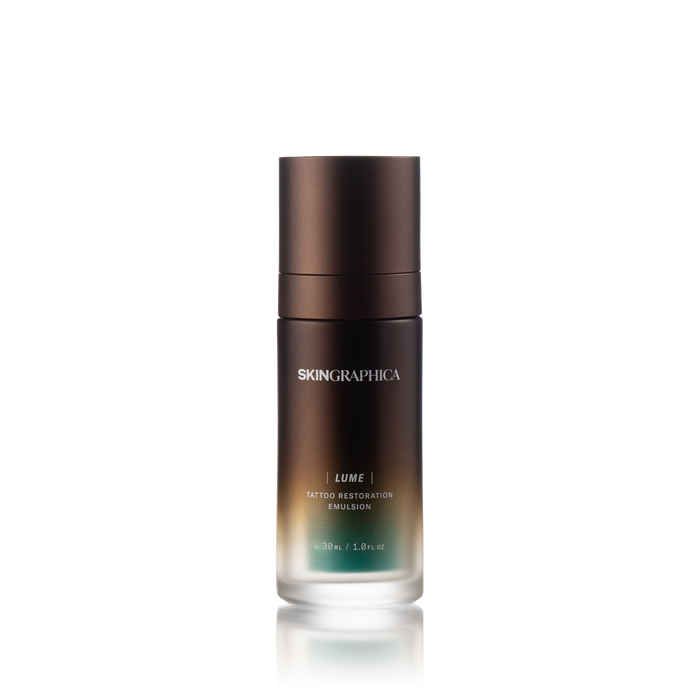
LUME
A world-first restoration emulsion, clinically engineered to revive the look of faded tattoos in as little as 10 days. Restores clarity, depth and dimensional lustre to older ink.


