

Signs of Life
Why we mark ourselves, what the most common symbols have always meant, and the honest answer to whether a picture can reveal the person wearing it.
Ask anyone with a tattoo what it means and you will almost never get a shrug. There is a name, a date, a person, a place, a private vow. Even the small and seemingly frivolous pieces tend to arrive with a story attached, told a little sheepishly and held rather close. Whatever else a tattoo is, it is rarely just a picture. It is a meaning someone decided to carry where they could see it.
That instinct, to make a mark stand for something, is the most consistent thing about tattoos across the whole sprawling, mainstream, modern population. The designs vary without end. The reasons behind them turn out to be surprisingly few, and surprisingly tender.
Why we mark ourselves
When a large survey of American adults asked tattooed people why they had done it, one answer towered over the rest. The most common reason, given by more than two-thirds, was to honour or remember someone or something. Not fashion, not rebellion, not decoration. Memory. Just under half said a tattoo of theirs makes a statement about something they believe, and about a third pointed to improving their appearance. People could give more than one reason, which is why the figures overlap, but the order of them says a great deal.
By The Numbers
Why people say they get tattooed
Reasons US adults give for getting any tattoo, Pew Research Center, 2023. Figures exceed 100% because respondents could give more than one reason. Women name honouring or remembering more often than men (73% vs 63%).
There are gentle patterns inside the data. Women are more likely than men to name remembering or honouring as a reason, by about ten points. Other surveys, asking the question a little differently, surface the same hierarchy, with self-expression, creativity and the marking of a hard-won experience close behind. Whatever the wording, the picture holds. Most tattoos are acts of devotion before they are anything else.
Most tattoos are not decoration. They are someone we love, kept where we can see them.
A short lexicon of the common symbols
For all that variety, a surprisingly small cast of symbols does most of the work, and each carries a meaning inherited across centuries and cultures. None of it is law. A symbol means whatever its wearer wants it to mean, and the same image can carry opposite weights depending on colour, placement and the company it keeps. But the traditional vocabulary of symbols is worth knowing, because it is the shared language most pieces are speaking, even when they bend it.
Heart
Love and devotion in their plainest form. Broken or bleeding, it becomes the loss of them.
Rose
Beauty and deep love, and often remembrance. Its colour shifts the meaning from passion to grief.
Anchor
Steadiness and a firm hold on what matters. A maritime emblem of home and safe return.
Swallow
Freedom and the journey home, carried by sailors as a promise that they would make it back.
Lion
Courage, strength and leadership. The nerve to stand at the front of things.
Wolf
Loyalty and family, the bond of the pack placed above the individual.
Skull
Mortality, and the resolve to live fully in its shadow. Often a mark of survival against the odds.
Lotus
Spiritual growth, and beauty that rises clean from difficult ground. A Buddhist and Hindu emblem.
Compass
Direction and guidance. A reminder of where, and to whom, you are headed.
Semicolon
A sentence the author chose not to end. A quiet mark of having continued through a hard season.
Read down that list and the theme repeats. The most enduring symbols are almost all about love, loss, direction or survival, the same handful of things human beings have always most needed to hold on to.
Love and memory
It is no accident that the single most common reason runs straight through the warmest part of that lexicon. The biggest category of tattoos, by some distance, is the one that keeps a person close. Names and dates. A line of someone's handwriting traced from an old letter. A portrait. The coordinates of a birthplace. A child's drawing rendered in clean line. A small paw print for a dog who is gone.
These are the pieces that turn the body into something closer to a locket than a gallery. When more than two-thirds of tattooed people say memory is part of why they did it, this is what they mean. The tattoo is a way of refusing to let distance, or even death, have the last word about who stays with you.
Belief and belonging
The next layer down is conviction. Nearly half of tattooed people say at least one of their pieces makes a statement about what they believe, and the symbols follow. A cross, an Om, a hamsa, a verse. A single word chosen as a private compass. A value rendered as a line of script along a forearm. The semicolon, worn as a small signal of solidarity by people who have come through a mental-health struggle and want to mark the fact that the sentence kept going.
Belonging lives here too. The crest of a team, the emblem of a regiment, the symbol of a faith or a family, the matching piece shared between people who want a bond made visible. These are tattoos that answer the question of which group you have chosen to stand inside.
The passion and the pastime
Then there are the tattoos that come from what a person loves to do. The musician's notes and lyrics. A wave for the surfer, a mountain range for the climber, a single contour line of a favourite trail. The tools of a trade worn by the person who practises it. The breed of a dog, the make of a guitar, the small icon of a game or a film that shaped someone early.
These answer a different question again. Not who do you love, or what do you believe, but what do you spend your one life doing when the choice is yours. They are among the most cheerful tattoos people carry, and often the most personal, because a passion is rarely borrowed.
So can a symbol reveal the person?
Here is where the fun begins, and where the honest answer disappoints the parlour game. We love to believe that the symbol is a key to the soul, that the woman with the dagger is dangerous and the man with the swallows is sentimental. Dating profiles and first impressions run on exactly this assumption. The evidence does not support it.
As a group, tattooed people do tilt very slightly towards certain traits, a touch higher on openness to experience, on extraversion, and on the need to feel distinct from the crowd. But the effects are small, a faint statistical lean across a third of the adult world rather than a fingerprint you can read off a forearm. And when a 2025 Michigan State University study photographed hundreds of tattoos and asked strangers to judge the wearers, the strangers agreed with one another and were, on almost every count, wrong. They read menace into death imagery and warmth into flowers, and missed the real people standing behind both.
One of the eighteen things a tattoo seems to reveal about its wearer survives scientific scrutiny: how open they are to new experience.
Only one signal held up. Genuinely odd, playful, hard-to-place tattoos really did tend to belong to people higher in openness, the trait of the curious and the unconventional. Everything else observers thought they saw was their own imagination handed back to them. We took that study apart in full in The Liar's Canvas, but the short version is simple. A symbol is a remarkably honest record of what a person values and a remarkably poor guide to who they are underneath it.
A symbol tells you what someone loves, not who they are.
What the ink is for
Step back from the whole picture and the throughline is clear. Strip away the styles and the trends and the endless catalogue of designs, and a tattoo is almost always a meaning made permanent, and usually a loving one. A person kept close. A belief worn outward. A passion that defines a life. The symbol on the surface is just the handle. The thing it carries is the point.
Which is exactly why it deserves to last. A name that blurs, a portrait that greys, a memorial gone soft at the edges, all of them slowly lose the very thing the tattoo was made to keep. This is the part SKINGRAPHICA® has always cared about most. A system built for the full life of ink, preparing the skin, recovering it through healing, defending it against the sun and the years, and restoring colour that time has taken, is in the end a way of protecting meaning, not merely appearance. Whatever your symbol stands for, it is worth keeping sharp enough to read.
The Complete System
A clinical, stage-targeted protocol engineered for the lifecycle of your ink.
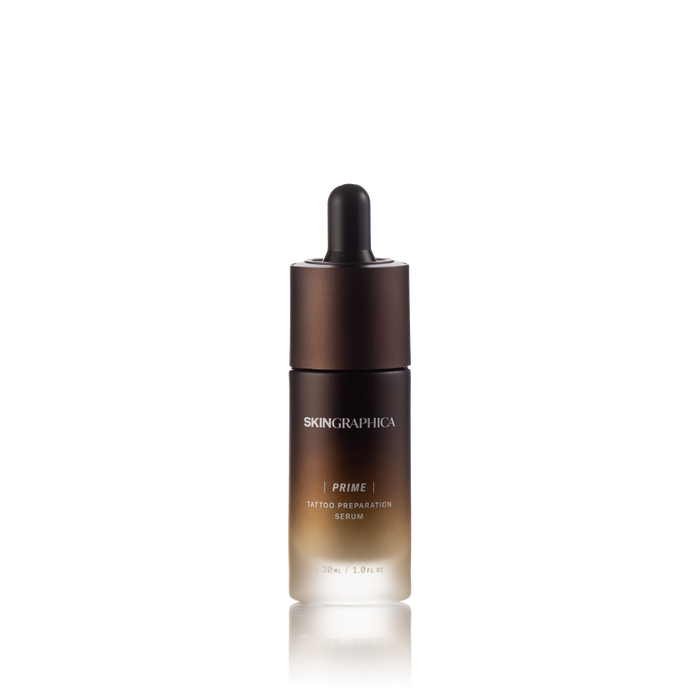
PRIME
Conditions and hydrates the canvas before the needle. Ceramide-rich for cleaner line work and smoother pigment saturation.
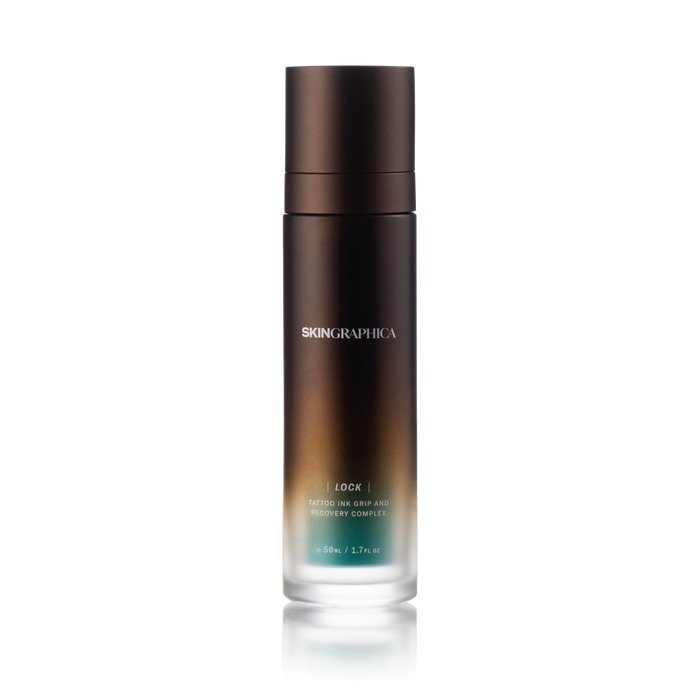
LOCK
A breathable recovery complex using Ink-Safe™ biochemistry to stabilise pigment and rebuild the barrier through the critical healing window.
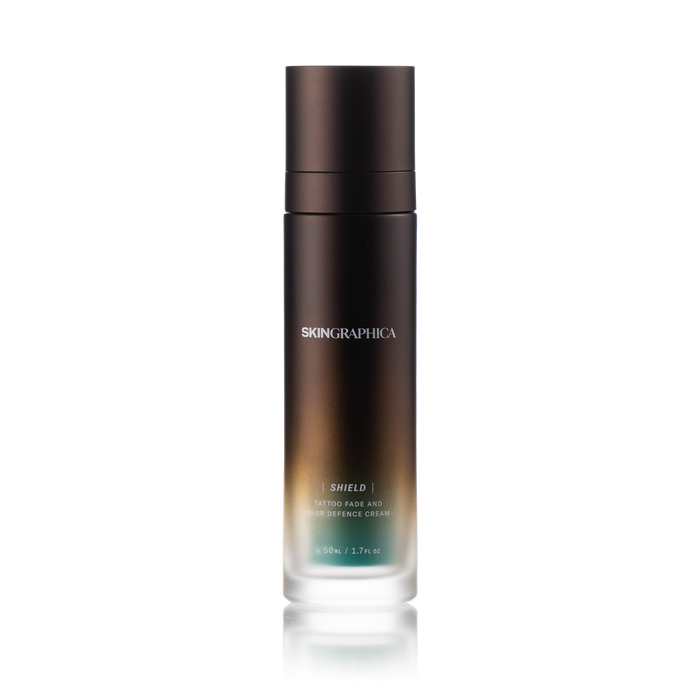
SHIELD
A transparent Fade and Blur Defence Cream. 360-degree shielding against UVA/UVB, HEV blue light, and urban pollutants with zero white cast.
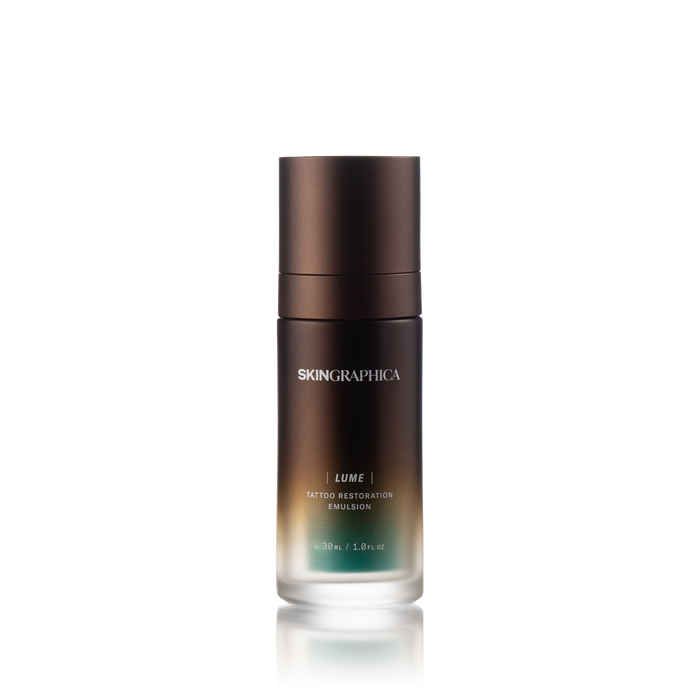
LUME
A world-first restoration emulsion, clinically engineered to revive the look of faded tattoos in as little as 10 days. Restores clarity, depth and dimensional lustre to older ink.


