


ICONICA · Editorial · September 2026
The Barometer on Your Arm
Why old tattoos itch, swell and go raised years later, what the folklore about rain gets right, and the one kind of flare that deserves a doctor.
Every tattoo forum on earth has the thread. The wording changes, the tattoo changes, the number of years changes, but the question is always the same. My tattoo is six years old. It healed perfectly. This week it is raised, it itches, and I can feel every line with my eyes closed. Is this normal?
The replies are a folk science all of their own. It's the heat. It's the humidity. It happens before it rains. Mine does it when I'm run down. Mine does it in the sun. And somewhere near the bottom, one person who has never had it happen, insisting the whole thing is imaginary.
It is not imaginary. It is one of the most common things a healed tattoo does, it is almost never discussed in the chair, and the science behind it is stranger and more interesting than any of the answers on the thread. It also has, tucked inside it, a rare and important exception that everyone with ink should know how to recognise.
The most common complaint nobody talks about
When the Tattoo Clinic at Bispebjerg University Hospital in Copenhagen, one of the few dedicated tattoo dermatology units in the world, surveyed young tattooed people, the headline finding was not infection or allergy. It was minor symptoms: itching, swelling, a prickling sensitivity, and above all a reaction to sun, which the clinic's founder Jørgen Serup went on to report in about one in five tattooed people. A later study of thousands of tattooed Danes and a large German population study both found the same thing. Pain, itch and swelling in an otherwise healed tattoo were the most common complications reported, and the amount of ink did not seem to matter. Small pieces did it as readily as sleeves.
In other words the raised tattoo is not a fringe phenomenon. It is closer to the rule than the exception. What is missing is an explanation, and for that you have to look at what a healed tattoo actually is.
What is under there
A healed tattoo is not ink sitting quietly in skin. As we explained in The Science of Why Tattoos Are Permanent, the pigment is held in place by immune cells that swallowed it and never left, packed into a fine mesh of collagen the skin laid down while it repaired the thousands of needle wounds that put the ink there. That mesh is, in the plainest terms, a very thin, very organised scar, running through the dermis in the exact shape of the design. And living alongside it, as they live everywhere in skin, are mast cells: the body's alarm cells, loaded with histamine and primed to release it whenever the tissue around them is warmed, stretched, irritated or provoked.
Now add heat. Blood vessels in the dermis widen and the tissue takes on fluid. Scar tissue does not expand at the same rate or in the same way as the softer skin around it, so the lines of the tattoo, which are also the lines of the scar, stand up in relief. The mast cells, warmed and jostled, let go of a little histamine, and histamine is the molecular definition of an itch. Sweat, friction from clothing and a burst of ultraviolet all push the same buttons.
The lines of the tattoo are also the lines of the scar. Warm them and they stand up.
Put those together and you get the raised, itchy, slightly tender tattoo on a hot afternoon, in a sauna, after a run, on holiday, under a fever. It rises, it itches, it subsides in hours or a day, and it leaves no trace. Nothing has gone wrong. The tattoo is behaving like the living tissue it is.
The rain question
Which brings us to the folklore. Enough tattooed people swear their ink flares before wet weather that the idea deserves a fair hearing rather than an eye-roll, and on a fair hearing it comes out about half right.
There is no controlled study showing tattoos respond to barometric pressure, and the mechanism is hard to imagine. But the weather that arrives before rain is not just lower pressure. It is warmer, closer and far more humid, and humidity does something specific to skin: it hydrates the outer layer, which swells, softens and tightens over the scar mesh beneath it. Warmth widens the vessels. The two together are precisely the recipe from the previous section. So the person who says their tattoo knows when a storm is coming is not wrong about the observation. They are wrong about the instrument. Their tattoo is a thermometer and a hygrometer. It is not a barometer.
The same logic explains the flares people report when they are sick or exhausted. A fever warms the skin from the inside, and an immune system that has been stirred up for any reason tends to stir the mast cells with it. The tattoo is not causing anything. It is reporting.
The slow allergy
So far, so benign. But some raised tattoos are not reporting the weather. They are reporting an allergy, and tattoo allergies have a property that makes them unlike almost any other: they can take years to arrive.
The literature holds cases of allergic reactions appearing anywhere from days after tattooing to seventeen years later. Red is the notorious culprit. In one review of published cases, red ink accounted for eleven of twenty-six reactions, a legacy that dates back to when red was made from cinnabar, which is mercury sulphide, and continues into the modern era of azo and quinacridone reds. Blue and green pigments from the phthalocyanine family are the next most common, though a long way behind. Black, the colour in almost every tattoo, is rarely responsible.
17 years. The longest documented delay between a tattoo going in and an allergic reaction to it appearing.
Why the delay? The Copenhagen clinic found something surprising when it patch-tested ninety patients with clear tattoo reactions against the very inks that had caused them. The tests came back negative. The pigment in the bottle was not the allergen. The best explanation, and the one the clinic proposed, is that the allergen is manufactured inside the skin: sunlight, enzymes and time slowly break the pigment particles into fragments the immune system has never seen before, and eventually one of those fragments is recognised as an enemy. The tattoo did not become allergenic on the day it was done. The body built the allergy, molecule by molecule, over years, and sun exposure is the accelerant.
An allergic tattoo does not look like a weather flare. It does not come and go with the afternoon. It is confined to one colour, typically the red, and it stays: raised, firm, often scaly or plaque-like, sometimes weeping, and persistently itchy for weeks rather than hours. Serup's group has compared the misery of a chronic tattoo reaction to that of serious itching skin disease, and people who have one tend to agree.
When the tattoo is telling you something else
There is a rarer category still, and it is the reason this article exists.
Sometimes the bumps that appear in an old tattoo are granulomas, small organised clusters of immune cells, of exactly the kind seen in a condition called sarcoidosis, a disease in which the immune system forms such clusters in the lungs, lymph nodes, eyes or skin. Tattoo pigment appears to be one of the things that can provoke them in a susceptible person, and the tattoo is frequently where they show up first. In one series, fourteen of nineteen patients with sarcoid-type reactions in their tattoos were subsequently diagnosed with the systemic disease, after delays ranging from one year to forty-five. Dermatologists now regard a sarcoid change in a tattoo as a prompt to look further, not a curiosity.
The pattern to recognise is bumps that arrive across every tattooed area at once, regardless of colour, and stay. One published case involved a professional boxer whose entire body of ink developed firm papules five years after it was done; his artist told him it was "just the ink". It was not. Another mimic worth knowing about is low-grade infection with environmental mycobacteria from contaminated ink, which can look like allergy and is treated entirely differently.
None of this should frighten anyone. These are rare. But the rule that separates them from the ordinary raised tattoo is simple enough to keep in your head. A flare that comes with heat, sweat, sun or weather, affects the whole piece evenly, and settles within a day is the living tissue reporting its environment. A change that is confined to one colour, or that appears across all your tattoos at once, and that persists for weeks, is a reason to see a dermatologist and to mention the tattoo when you do.
What to do about the itch
For the ordinary flare, the everyday one, the advice is mostly about resisting instinct.
Do not scratch. Scratching a healed tattoo will not remove ink, but it wakes more mast cells, prolongs the flare and can leave the surface scuffed and dull. Cool the area instead: a cold compress, a cool shower, or simply getting out of the heat that started it. Keep the skin barrier well hydrated, because a dry, tight outer layer over a swollen scar is the most uncomfortable combination there is, and well-conditioned skin flares less and settles faster. A single dose of an ordinary antihistamine will take the edge off a bad afternoon. Resist reaching for steroid creams on unbroken tattooed skin without a dermatologist's say-so; they thin the tissue you are trying to protect.
And take the sun seriously, for a reason beyond fading. Ultraviolet is the trigger for the one-in-five who get sun-reactive tattoos, and it is the accelerant for the slow allergies described above. Daily protection over your ink is not only how you keep the colour. It is how you keep the peace. Our sunscreen guide covers what to use and how.
The verdict
A tattoo is permanent because the body decided to keep it, and the body does not keep things passively. It builds a scaffold around them, stations guards beside them and reacts, for the rest of your life, to whatever is happening around them. Most of the time that reaction is a shrug in the heat: a raised line, an itch, an hour of feeling your own artwork. Occasionally it is the first sign of something that deserves attention, and knowing the difference is worth more than any cream.
The next time your old ink stands up on a close, heavy afternoon, you can tell the person beside you that it is about to rain, and you will very probably be right. Just know that the credit belongs to the humidity, and to the quiet, permanent, faintly irritable colony of cells that has been holding your tattoo in place since the day it went in.
Frequently asked questions
Why is my old tattoo raised and itchy?
Most often heat, humidity, sweat or sun. A healed tattoo is held in a fine scar mesh alongside histamine-releasing mast cells; warmth swells the tissue and triggers the itch. It usually settles within hours to a day.
Can a tattoo really predict rain?
Not through air pressure, but the warm, humid conditions that precede rain do cause tattoos to swell and itch. The observation is real; the instrument is a hygrometer, not a barometer.
Can you become allergic to a tattoo years later?
Yes. Reactions have appeared up to seventeen years after tattooing, most often to red ink. Research suggests the allergen forms slowly inside the skin as pigment breaks down, with sun exposure speeding the process.
When should I see a doctor about a raised tattoo?
When the change is confined to one colour, or appears across all your tattoos at once, and lasts for weeks rather than hours. Persistent, firm, scaly or weeping areas need a dermatologist.
How do I stop a healed tattoo itching?
Do not scratch. Cool the skin, get out of the heat, keep the barrier hydrated, and take an antihistamine for a bad flare. Daily sun protection reduces how often it happens.
The Complete System
A clinical, stage-targeted protocol engineered for the lifecycle of your ink.
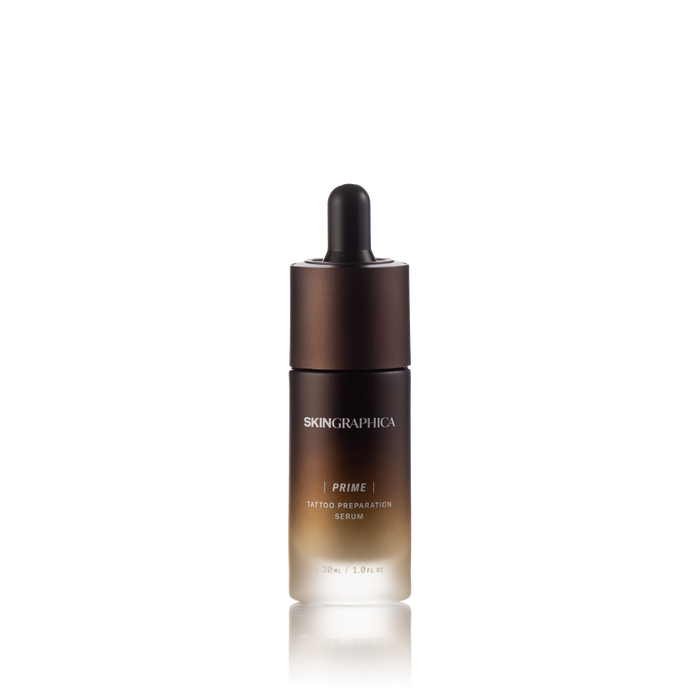
PRIME
Conditions and hydrates the canvas before the needle. Ceramide-rich for cleaner line work and smoother pigment saturation.
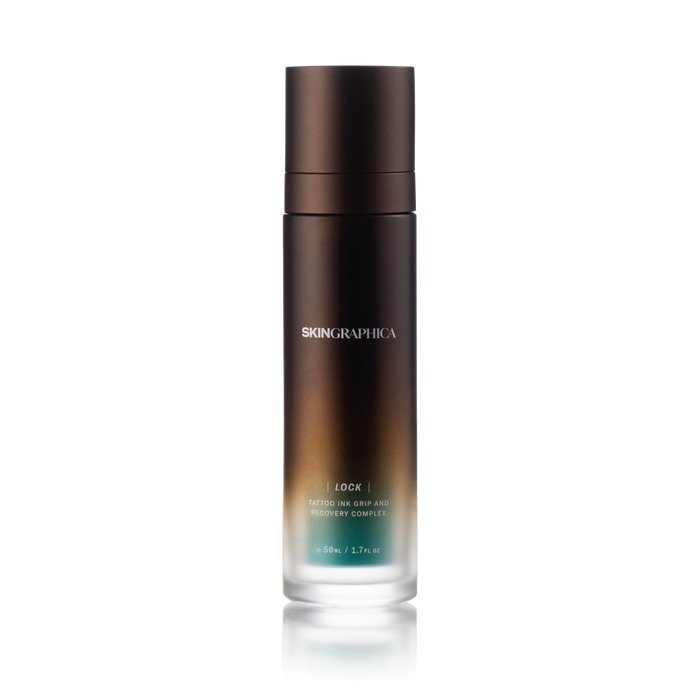
LOCK
A breathable recovery complex using Ink-Safe™ biochemistry to stabilise pigment and rebuild the barrier through the critical healing window.
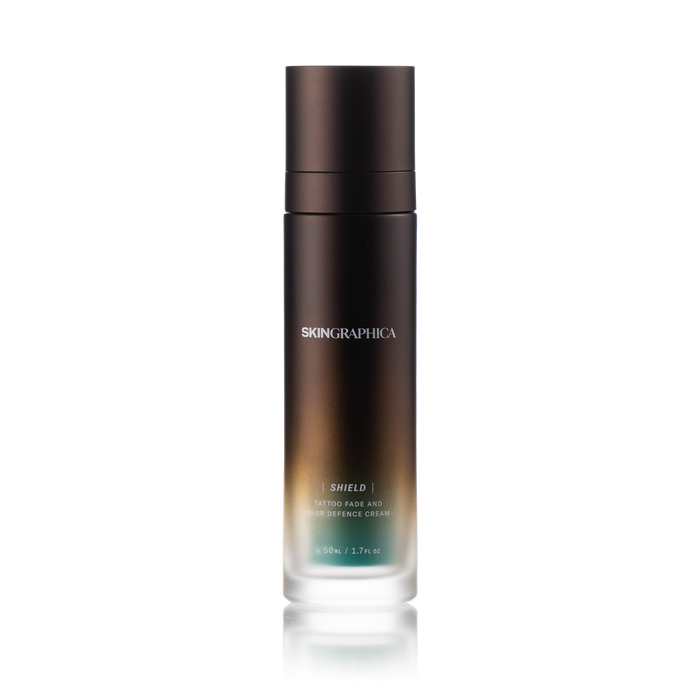
SHIELD
A transparent Fade and Blur Defence Cream. 360-degree shielding against UVA/UVB, HEV blue light, and urban pollutants with zero white cast.
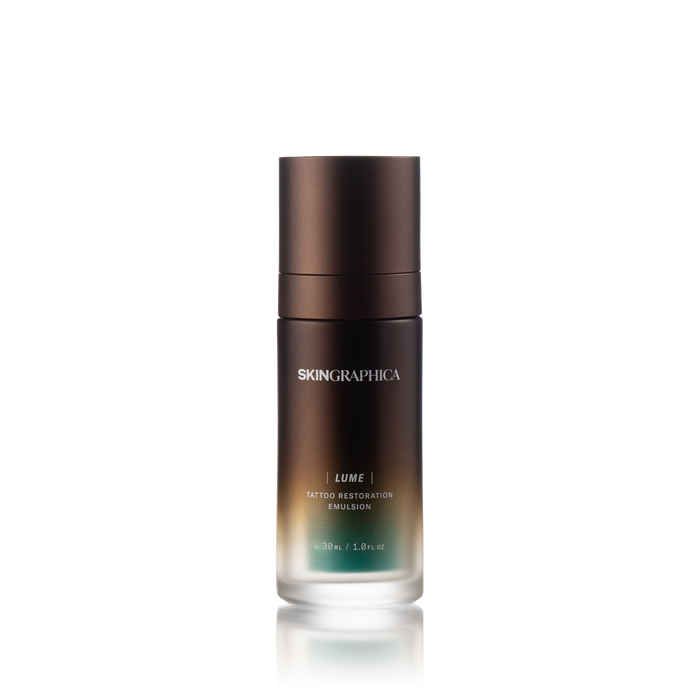
LUME
A world-first restoration emulsion, clinically engineered to revive the look of faded tattoos in as little as 10 days. Restores clarity, depth and dimensional lustre to older ink.


