

A Patek Philippe goes back to the watchmaker every 5 years. A Monet hangs behind glass, under light held to 200 lux. A Bugatti spends the winter wrapped in film inside a filtered bubble. The finest tattoos in the world, works that take years to make and that major museums now queue to show, get almost nothing. They are also the only masterpieces that are alive, out in the sun every day and gone when their owner is. This is the case for treating the best tattooing as what it has become, fine art, and for caring for it the way every other serious collector already does.
The recognitionWhen the museum came for the tattoo
For most of the 20th century tattooing lived outside the gallery. That has changed, quickly and at the very top. From May 2014 to October 2015 the musée du quai Branly in Paris staged Tatoueurs, tatoués, curated by Anne and Julien of HEY! magazine. It drew 702,138 visitors, more than any other temporary exhibition in Paris in 2015, ahead of Jeff Koons at the Centre Pompidou. It went on to the Royal Ontario Museum in Toronto, the Field Museum in Chicago and the Natural History Museum of Los Angeles County.
“I think they are technically great artists and extremely creative.” Stéphane Martin, president of the musée du quai Branly, 2016
The fine art museums followed. In 2019 the de Young in San Francisco gave Ed Hardy what it billed as the first museum retrospective of a tattoo artist, more than 300 objects. Its director, Thomas P. Campbell, said “Ed Hardy reinvented the very nature of the tattoo.” London’s Somerset House showed the silk paintings of the irezumi master Horiyoshi III in 2012, and Horiyoshi III runs his own tattoo museum in Yokohama. The Museum of Fine Arts, Boston, opened Tattoos in Japanese Prints in 2021. The National Maritime Museum Cornwall commissioned 100 silicone arms, each tattooed with an original design by a leading British artist, for a survey of British tattoo art curated by Dr Matt Lodder. In 2012 the Louvre itself, at the opening of Wim Delvoye au Louvre, had a tattooed man sitting among the exhibits, press at the time reported.
And the Smithsonian?
It is often said that the Smithsonian now recognises tattooing as fine art. The truth is more precise, and more interesting. An online exhibition from the Smithsonian Center for Folklife and Cultural Heritage, The Art of Tattooing, says plainly that “tattooing also is among the fine arts.” Its subject is the Washington DC tattooist Charles “Coco” Bayron. The Smithsonian American Art Museum moved earlier and more quietly. In 1986 it added tattoo design work and equipment to its permanent collection, a gift from the collector Herbert Waide Hemphill Jr., and it catalogues a 20th century sheet of tattoo flash under Painting. The museum’s own public answer to “Are tattoos art?” is careful, and treats it as part of the larger question of what art is. That care deserves respect. Recognition is earned piece by piece and artist by artist.
Not everyone is there yet. In 2013 Lodder told the New Statesman he doubted he could get an article about an Ed Hardy back piece into any of the major art history journals. The galleries have moved faster than the academy. So have the collectors.
The marketThe tattoo that sold for €150,000
In 2006 the Belgian artist Wim Delvoye began tattooing the back of a Swiss man named Tim Steiner. The work, titled Tim, shows a Madonna with a halo crowned by a Mexican skull. In 2008 it was sold to the German collector Rik Reinking for €150,000, and Steiner received a third, according to the BBC. The contract obliges Steiner to exhibit the piece, and when he dies the skin passes to Reinking. He has sat on a plinth at MONA in Hobart for more than 3,500 hours. “My back is the canvas, I am the temporary frame,” he told The Art Newspaper. Delvoye was blunter. “It’s art because it got sold.” Who owns the art on a person’s skin is a question the courts are still answering.
Tim is an extreme case, but the principle reaches every serious tattoo collector. The luxury end of tattooing is made by a small number of artists, booked far ahead and paid like the masters they are. The Pitt Rivers Museum at Oxford notes a full Japanese body suit can take up to 5 years of weekly visits and cost more than £15,000. In New York JonBoy’s minimum was reported at US$300 an hour in 2016, and Eva Karabudak’s starting rate at US$600 an hour in 2023. Studios offering tattooing under sedation sell packages from around US$30,000 to US$100,000. The artists in Black Ivy, the Global Top 10, and GRAPHICA, the Global Top 100, are booked months and sometimes years ahead.
Add the hours in the chair and a large piece by a great artist is an asset in every sense but one. It has no agreed value, no condition report and, almost always, no plan for its care.
The collector’s codeHow the world looks after what it values
Every other field of serious collecting has settled the same question the same way. Protect the original. Control what wears it down. Restore as little as possible, and only by the right hands.
Watches. Why nobody polishes a Rolex
Watch collecting runs on one word, originality. Christie’s warns that “restoring a watch to how it used to look can reduce the value of a timepiece” and lists case polishing among the things that cut value. Sotheby’s describes what polishing does to a vintage Rolex sports model. “The sharp bevels become muddy or completely disappear.” Aurel Bacs, the auctioneer behind many of the records, puts it most simply. “Even with flaws, even with stains, even with dirt, originality goes first.”
The makers think the same way. Rolex refinishes a case at service only on request. Audemars Piguet’s restoration workshop in Le Brassus is committed to the principle of originality and treats patina as “a precious testimony to the watch’s life.” Patek Philippe recommends a service every 5 years. The reward shows at auction. Paul Newman’s own Rolex Daytona sold for US$17,752,500 at Phillips in 2017. A steel Patek Philippe Grandmaster Chime made CHF 31 million at Christie’s in 2019, the most expensive wristwatch ever sold at auction according to Guinness World Records.
Cars. Film, bubbles and original paint
The car world is no different. Owners wrap the paint of a Pagani, a Bugatti or a Ferrari in transparent protection film that can cost as much as US$8,000 for a full car, according to Edmunds, and park it in sealed enclosures their maker says keep out moisture and dust. Pagani’s Rinascimento program restores its cars with carbon parts made in the original moulds, kept for that purpose. Bugatti offers Veyron owners a Collector profile for cars driven no more than 200km a year.
The highest honour goes to the car that was looked after, not remade. At Pebble Beach in 2024, Best of Show went to a 1934 Bugatti Type 59 still wearing its original paint and faded varnish, the first winner ever from the Prewar Preservation class. Preservation judging there penalises excessive polishing. FIVA’s Charter of Turin, the heritage rule book for historic vehicles, asks that any change be reversible. The most valuable car ever sold, a 1955 Mercedes-Benz 300 SLR Uhlenhaut Coupé, made €135 million in 2022.
Paintings. The discipline of the lux meter
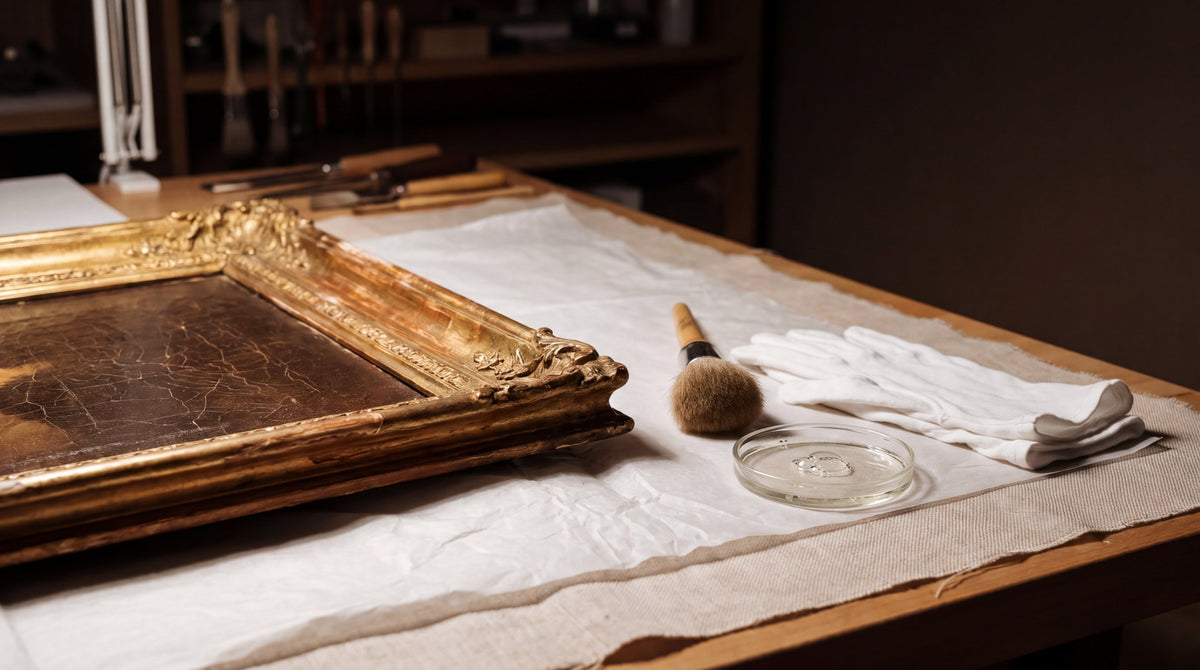
Museums are stricter still, because they have learned that “all damage is cumulative and irreversible,” in the words of the US National Gallery of Art. Light is managed as a dose, its intensity multiplied by time. Oil paintings are kept to around 200 lux and works on paper to 50, with a yearly budget of lux hours. Galleries hold relative humidity between 40 and 60% and temperature between 16 and 25°C. Makers of museum glass claim it blocks up to 99% of UV.
All of it protects canvases worth almost unimaginable sums. Banksy’s Girl with Balloon sold for £1.04 million in 2018, shredded itself in the frame, and resold as Love is in the Bin for £18.6 million in 2021. Warhol’s Shot Sage Blue Marilyn made US$195 million in 2022, the highest auction price for an American artwork. Monet’s Meules made US$110.7 million in 2019, and Salvador Dalí’s Portrait de Paul Éluard £13.48 million in 2011.
Fashion. Even leather has a workshop
Louis Vuitton runs 12 repair ateliers and dates its first recorded repair to 1860. Hermès says all of its objects can be repaired and freshened up. Nobody sends a Balenciaga couture gown through a hot wash. Jane Birkin’s original Birkin sold for €8.6 million at Sotheby’s in Paris in 2025, the most expensive handbag ever sold at auction.
None of this is a niche habit. Deloitte and ArtTactic estimated the art and collectibles wealth of the world’s ultra high net worth individuals at US$2.174 trillion in 2022. Knight Frank’s Luxury Investment Index is up 38.6% over 10 years. Care is simply what serious collectors do.
| The object | The care standard | Who says so |
|---|---|---|
| Patek Philippe watch | A full service every 5 years | Patek Philippe |
| Vintage Rolex | The case left unpolished, because polishing blurs the bevels | Sotheby’s and Christie’s |
| Supercar paint | Transparent protection film, up to US$8,000 a car | Edmunds |
| Prewar Bugatti | Original paint kept, excessive polishing penalised | Pebble Beach preservation judging |
| Oil painting | Light held to about 200 lux | Museums Galleries Scotland |
| Watercolour or print | 50 lux and a yearly light budget | Museums Galleries Scotland |
| Gallery climate | 40 to 60% humidity, 16 to 25°C | IIC and ICOM-CC |
| Louis Vuitton trunk | 12 repair ateliers | Louis Vuitton |
| A tattoo by a ranked artist | Usually nothing at all | The bathroom cabinet |
The paradoxThe most fragile masterpiece in any collection
Here is the irony. Of everything a collector might own, the tattoo is the most fragile and the least protected. A watch is steel. A painting is pigment on linen in a room built around it. A tattoo is pigment held inside a living organ that renews itself, ages and goes out into the sun every day of its owner’s life.
Ink does not simply sit in the skin. In 2018 researchers in France showed in tattooed mice that pigment is held by immune cells in the dermis called macrophages. When those cells die they release the pigment and new macrophages take it up again, a cycle of capture, release and recapture the authors describe as continuous. A tattoo is not a fixed object. It is held in place by a living process. Our essay on why tattoos are permanent goes deeper.
That process leaks, and tattoo fading is the result. In a 2010 study in mice a red pigment fell by about 32% in 42 days, and simulated sunlight pushed the loss to around 60%, partly by breaking the pigment down. In human skin, a 2011 study of red tattoos estimated that 87 to 99% of the original pigment had gone in the years after tattooing, broken down in the skin or carried away through the body. Laboratory work has found that one family of pigments, the azo pigments, degrades in sunlight while others are far more stable. A model from University College London found that fine detail is lost first, and that the finest designs may lose their definition after about 15 years. The studies are small and the science is young, but they all point the same way. More in our guide to why tattoos fade.
The canvas changes too. The outer layer of skin replaces itself about every 4 weeks, and the dermis thins by around 20% with age. The American Academy of Dermatology says ultraviolet light can fade some tattoo inks. Light, the enemy every museum manages to the lux, falls on a tattoo all day.
And unlike every other object in this essay, a tattoo cannot easily outlive its collector. Tim’s skin will pass to a collection. The Wellcome collection in London holds about 300 pieces of tattooed human skin from the 19th and early 20th centuries. A foundation in Amsterdam will now preserve a tattoo after death, with a pathologist and silicone. For everyone else the work lasts exactly as long as the life that carries it. It is the only masterpiece that leaves with its owner.
A Monet can be rehung. A Rolex can be serviced. A tattoo has one canvas and one lifetime.
The touch-upWhy a touch-up is a polished Rolex
When a watch loses its lustre, the temptation is to polish it. Every serious collector knows the cost. Polishing removes metal, softens the lines the maker cut and can take value with it. The tattoo world has its own version. When a piece fades it usually goes back under the needle.
A touch-up can bring back colour and contrast, and done by the original artist it can be the right call. But it is new work laid over old, and part of the original hand is replaced. One artist told Allure a faded tattoo “will most likely need a full revamp,” often with the lines redone. Another put the collector’s view simply. “I usually recommend that people let their tattoos age with them.”
There is a whole industry for the tattoos people want gone. About 1 in 4 tattooed Americans regret at least one piece, Pew Research found in 2023, and Fortune Business Insights valued the tattoo removal market at US$1.29 billion in 2025. There is far less for the people who love their work and want to keep it as it was made. The best answer from every other field is the same. Protect the original so it never needs restoring.
Tattoo preservationWhat museum care looks like on skin
Translate the conservator’s rules to skin and they become a simple discipline. None of it is complicated. It is just rarely done.
- Light. Dermatologists recommend daily sun protection for tattooed skin once it has recovered. Light damage, as every museum knows, is a dose that adds up. See our guide to tattoo sunscreen.
- Surface. A tattoo is seen through the skin above it. Dull, dry skin flattens even the finest work.
- New work. The first weeks set the lines. Prepare the skin before the needle and protect it while it recovers.
- Older work. Restore definition from the surface before reaching for the needle.
SKINGRAPHICA® was built on that logic. Every formula is dermatologist approved, clinically proven and independently lab tested, and every one is held in airless glass and pump dispensed, shielded from light and untouched by fingers. It is the museum vitrine, applied to the care itself.
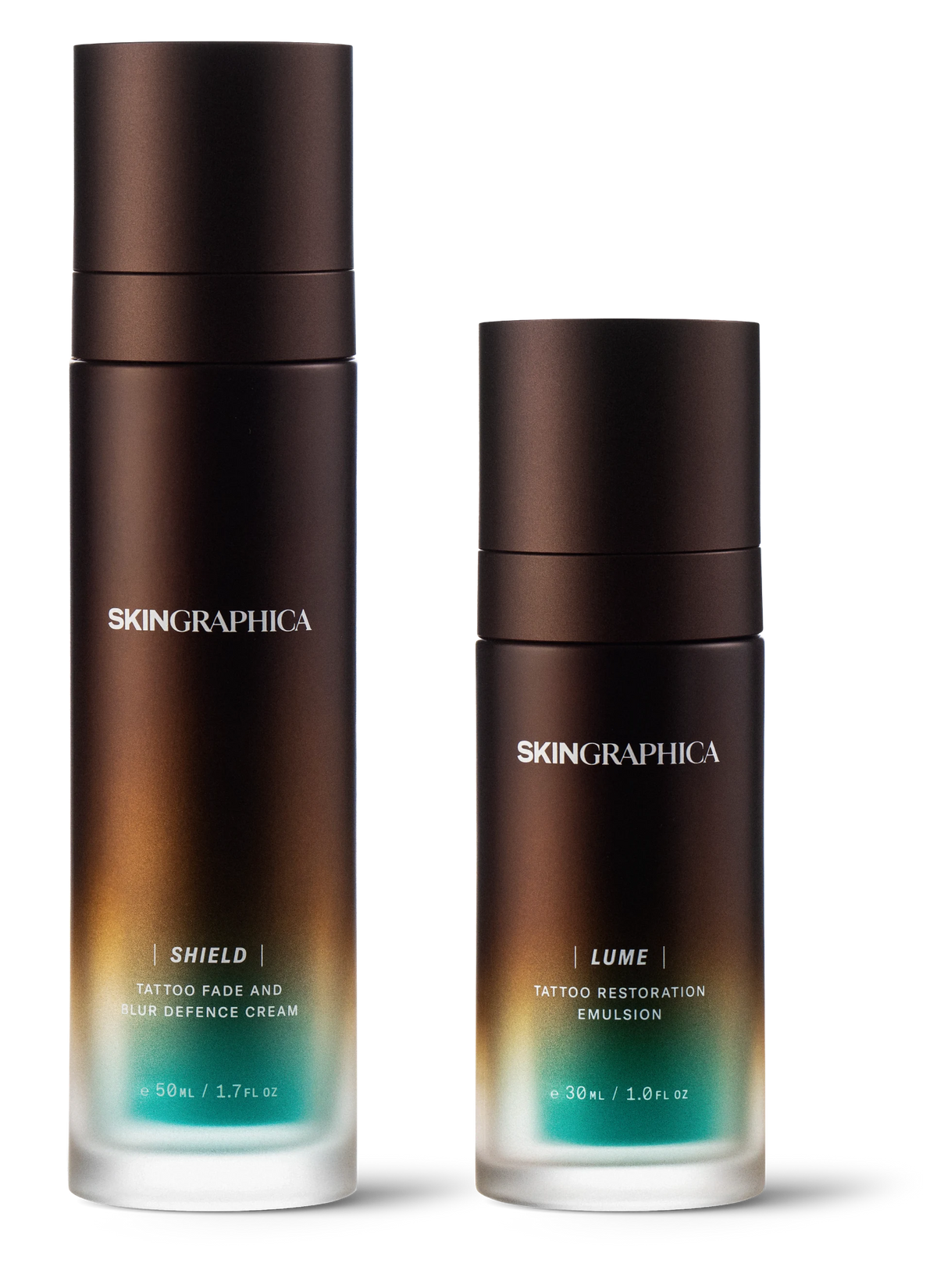
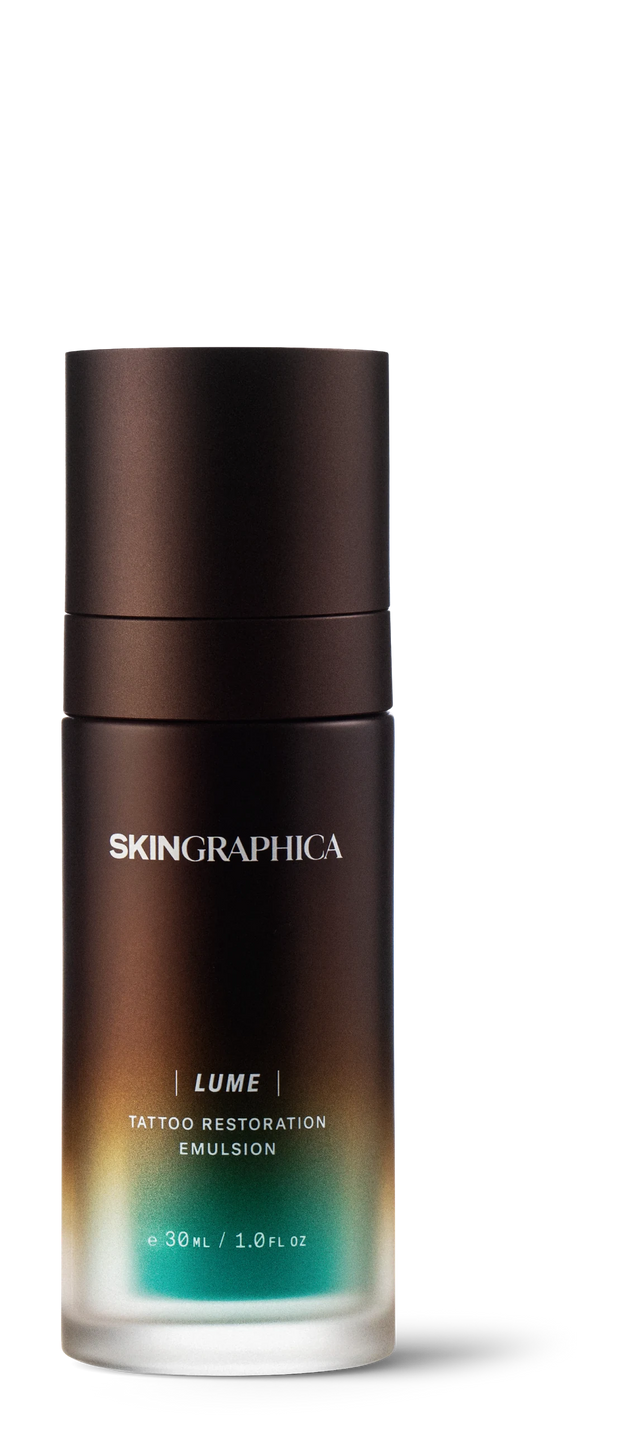
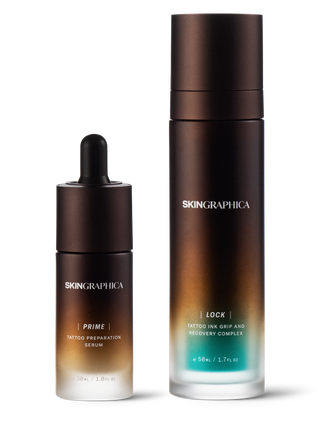
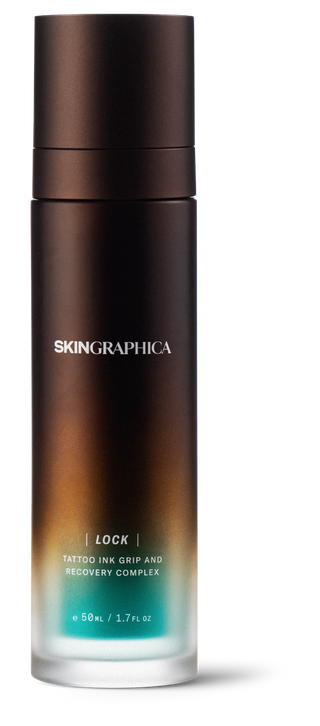
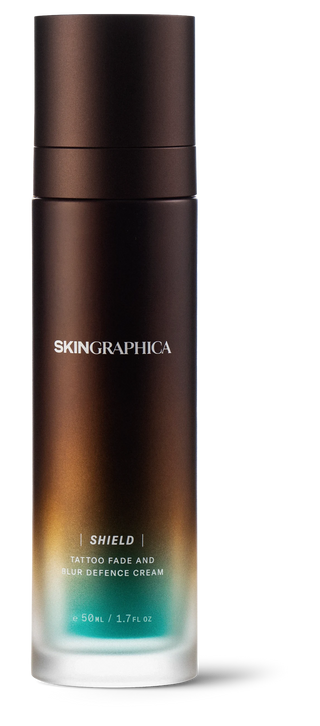
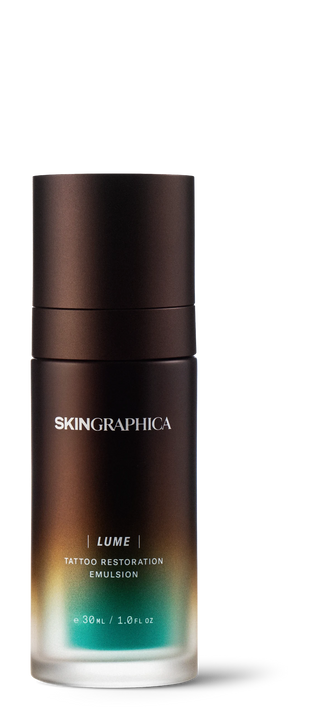
For the pieces you already wear there is LEGACY, the restoration collection. LUME brings back the depth and definition the years have taken, with visible restoration in as little as 10 days, and 93% said it improved the overall appearance of their tattoo. SHIELD keeps it there every day after, going beyond sunscreen with SPF 15, HEV blue light defence and resveratrol, with no white cast. For new work, PRIME strengthens the skin before the needle so the lines sit sharp, and LOCK helps hold the pigment while the skin recovers. For the serious collector, with new work on the way and older pieces worth restoring, SYSTEM LUX brings the complete collection together in the collector’s edition box.
An honest wordWho SKINGRAPHICA® is for, and who it is not
We should be straight about this. Not every tattoo needs a collector’s regimen, and not every bathroom cabinet needs SKINGRAPHICA®. If your tattoo cost a few hundred dollars and you love it as it is, a good sunscreen and a decent moisturiser will serve it well. We would rather say so than sell you something you do not need.
SKINGRAPHICA® is made for the other end of the market. For the collector who waited a year for a ranked artist, sat for dozens of hours and wears a piece a museum would hang. For the body suits, back pieces and sleeves that are, in every sense that matters, fine art. Nobody needs museum glass for a poster. Everybody who owns a Monet uses it.
The world’s finest tattooing has earned its place in museums and at auction. The work on the skin deserves at least the care we give a watch.
Fine art, on the most fragile canvas there is
The best tattoos are shown by major museums and have been sold as art. Every other class of collectible, from Rolex and Patek Philippe to Bugatti, Monet and Louis Vuitton, is protected from light, wear and restoration that goes too far. A tattoo faces all 3 every day on a living canvas, and usually gets nothing. Treat great work like the art it is.
QuestionsTattoos as fine art, answered
Is tattooing considered fine art?
Increasingly, at the highest level, yes. The musée du quai Branly in Paris, the de Young in San Francisco and the Museum of Fine Arts, Boston, have all staged major tattoo exhibitions, and a Smithsonian online exhibition describes tattooing as among the fine arts. Academic art history has been slower to agree.
Does the Smithsonian recognise tattoos as art?
An online exhibition from the Smithsonian Center for Folklife and Cultural Heritage says tattooing “is among the fine arts”, and the Smithsonian American Art Museum has held tattoo flash and equipment in its permanent collection since 1986. There is no formal Smithsonian ruling, and the museum’s own answer to “Are tattoos art?” treats it as part of the question of what art is.
What is the most expensive tattoo ever sold?
The best documented sale is Tim, a tattoo by the Belgian artist Wim Delvoye on the back of Tim Steiner, sold to the collector Rik Reinking in 2008 for €150,000. Steiner exhibits it while he lives and the skin passes to Reinking after his death.
Do tattoos fade over time?
Yes. Studies estimate large losses of pigment in the years after tattooing, sunlight breaks down some pigments and fine detail is lost first. The American Academy of Dermatology says UV light can fade some tattoo inks.
How do you preserve a tattoo?
Treat it like any artwork that is sensitive to light. Protect it from the sun every day once it has recovered, keep the skin above it in good condition and care for new work closely in its first weeks. Restore the look of older work from the surface before reaching for the needle.
Is a touch-up like polishing a watch?
In one important way, yes. Both can bring back shine, and both replace part of the original. Collectors of vintage Rolex and Patek Philippe avoid polishing for that reason, and the same logic argues for protecting a great tattoo before it needs retouching.
Is SKINGRAPHICA® worth it for every tattoo?
No, and we would rather say so. A good sunscreen and moisturiser suit many tattoos well. SKINGRAPHICA® is made for collectors of significant work, the pieces by leading artists that are worth preserving as art.
Prices are as reported at the time of each sale and are not adjusted for inflation. The science figures come from small studies, mostly of red pigment, and are given as published. This essay is general information, not medical advice.
ReferencesSources
- Smithsonian Center for Folklife and Cultural Heritage, The Art of Tattooing, online exhibition, 2012
- Smithsonian American Art Museum, Ask Joan of Art. Are Tattoos Art?, 2011
- Smithsonian American Art Museum, Tattoo Flash, gift of Herbert Waide Hemphill Jr.
- Paris tourist office attendance results 2015, Tatoueurs, tatoués
- CBC, tattoo exhibition at the Royal Ontario Museum, 2016
- Field Museum, Tattoo, 2016
- Fine Arts Museums of San Francisco, Ed Hardy. Deeper than Skin, 2019
- Somerset House, Kokoro. The Art of Horiyoshi III, 2012
- Museum of Fine Arts, Boston, Tattoos in Japanese Prints
- University of Essex, British tattoo art at the National Maritime Museum Cornwall, 2017
- New Statesman, Will a tattoo ever hang in the Louvre?, 2013
- The Art Newspaper, Tim Steiner at MONA, 2020
- NPR, Wim Delvoye sells a tattoo, 2008
- Pitt Rivers Museum, Japanese irezumi
- Marketplace, tattoos under anaesthesia, 2024
- Christie’s, How to store and maintain your watch, 2019
- Sotheby’s, How to assess a watch’s condition, 2025
- Audemars Piguet, restoration workshop
- Patek Philippe, importance of maintenance
- Phillips, Paul Newman’s Rolex Daytona, 2017
- Guinness World Records, most expensive watch sold at auction
- Motor1, is paint protection film worth it
- Pagani, Rinascimento
- Motor1, Bugatti Type 59 wins Best of Show at Pebble Beach, 2024
- RM Sotheby’s, 300 SLR Uhlenhaut Coupé, 2022
- National Gallery of Art, effects of light exposure
- Museums Galleries Scotland, conservation and lighting
- ICOM-CC and IIC, environmental guidelines declaration, 2014
- The Art Newspaper, Love is in the Bin, 2021
- NPR, Shot Sage Blue Marilyn, 2022
- Sotheby’s, Monet Meules, 2019
- HENI, Dalí Portrait de Paul Éluard, 2011
- Louis Vuitton, repairs
- The Art Newspaper, Jane Birkin’s original Birkin, 2025
- Deloitte and ArtTactic, Art and Finance Report 2023
- Knight Frank, Luxury Investment Index, 2026
- Baranska and others, Journal of Experimental Medicine, 2018
- Engel and others, Experimental Dermatology, 2010
- Lehner and others, JEADV, 2011
- Hauri and Hohl, Tattooed Skin and Health, 2015
- UCL, how tattoos move with age, 2011
- American Academy of Dermatology, caring for tattooed skin
- Allure, why your tattoo faded, 2020
- Pew Research Center, tattoos in America, 2023
- Fortune Business Insights, tattoo removal market
- NPR, preserving tattoos after death, 2014