


ICONICA · Editorial · September 2026
The Ink in Your Lymph Nodes
Two Scandinavian studies linked tattoos to lymphoma and melanoma. Two meta-analyses found nothing. What the science actually says, and what a tattooed person should do with it.
In September 2017, a team from Germany's Federal Institute for Risk Assessment took skin and lymph node tissue from tattooed donors to the European Synchrotron in Grenoble and pointed one of the most powerful X-ray beams on earth at it. Surgeons already knew roughly what they would find: for decades, anyone who had operated on a heavily tattooed patient had seen lymph nodes stained blue, green or black. The synchrotron supplied the receipt. The same organic pigments, the same titanium dioxide, the same traces of nickel and chromium turned up in the skin and in the nodes that drained it. The ink does not stay where it is put.
That finding sat quietly in the literature for 7 years. Then, in May 2024, epidemiologists at Lund University in Sweden published a study of nearly 12,000 people that reported a 21% higher risk of lymphoma in the tattooed. The headline travelled the world in a day. The caveats did not, and neither did the 2 meta-analyses that followed and found no significant association at all.
This is an attempt to put the whole picture in one place. It is written by a company that sells skincare to tattooed people, which is a reason to read it carefully, and a reason we owe you the unvarnished version.
The short version
- Tattoo pigment migrates to lymph nodes. This is established, not speculative.
- A large Swedish study found a 21% higher relative risk of lymphoma, with a confidence interval that touched no effect. A follow-up found a 29% higher relative risk of melanoma and no link to squamous cell carcinoma.
- Two meta-analyses pooling every available study found no statistically significant association between tattoos and lymphoma.
- Lymphoma is rare. Even if the Swedish figure is exactly right, it means roughly 5 extra cases per 100,000 people a year.
- The researchers say the results apply to populations, not individuals, and are not grounds to avoid or remove tattoos.
Where the ink actually goes
A tattoo needle deposits pigment into the dermis, the living layer beneath the surface. Immune cells called macrophages swallow the particles, and their inability to digest them is what makes a tattoo permanent, a relay we described in The Science of Why Tattoos Are Permanent.
Not every particle is caught. Inks contain pigment from well under 100 nanometres to over a micrometre in size, and the smallest fraction can enter the lymphatic vessels that drain every patch of skin, travel to the nearest nodes and stop, because a lymph node is a filter. The 2017 synchrotron work found micrometre-scale particles in skin but only nano-scale particles in the nodes: the lymphatics act as a sieve.
What arrives is not just colour. Black inks are mostly carbon black, which can carry polycyclic aromatic hydrocarbons from manufacture. Coloured inks are largely azo compounds, some of which break down into primary aromatic amines under ultraviolet light or laser treatment. White is titanium dioxide. The Grenoble team detected biochemical changes in the tissue around the particles consistent with low-level chronic inflammation.
So the hypothesis is not exotic. A lymph node full of foreign particles is a node in a state of permanent mild alert, and lymphoma is a cancer of the immune cells that live there. The question is whether decades of that alert changes the odds.
The Swedish study
Sweden is one of the most tattooed countries in the world and keeps some of its best population registers. Christel Nielsen and her colleagues at Lund identified everyone diagnosed with lymphoma between the ages of 20 and 60 from 2007 to 2017, matched each to 3 people of the same age and sex without the disease, and asked them all about tattoos, smoking and education. The study population was 11,905 people; 1,398 cases and 4,193 controls answered.
Among those with lymphoma, 21% were tattooed. Among controls, 18%. Adjusted for smoking and education, that gap became an incidence rate ratio of 1.21, the source of the headline. The 95% confidence interval ran from 0.99 to 1.48: the true figure could be anywhere from essentially no increase to 48%, and the interval brushed the line of no effect. A broader, unmatched analysis tightened the estimate to 1.18 with an interval that cleared 1.0.
The pattern over time was odd. Risk looked highest in people whose first tattoo was under 2 years old, at 1.81, fell away for tattoos 3 to 10 years old, then rose again modestly after 11 years. And there was no dose-response at all: a full back piece carried no more risk than a single small tattoo, which is not what you would expect if the ink itself were the driver. The signal was strongest for 2 B-cell subtypes, diffuse large B-cell and follicular lymphoma, though neither reached significance on its own.
One finding buried in a table deserves more attention than it got. Among tattooed participants who had undergone laser removal, the risk estimate was substantially higher than for those who left their ink alone. The numbers were small and the interval wide, but it fits the chemistry: lasers do not remove pigment so much as shatter it into smaller pieces, which are easier for the lymphatics to carry away.
The evidence, side by side
Relative risk of lymphoma in tattooed people. Each bar is a 95% confidence interval; when it crosses 1.0, the study cannot rule out no effect.
Sources: Nielsen 2024 (incidence rate ratios); Clemmensen 2025 (hazard ratio); McConnell 2025 and Clinical and Translational Oncology 2026 (pooled odds ratios). Log scale. Measures differ between studies and are shown for orientation, not direct comparison.
22 in 100,000 People aged 20 to 60 diagnosed with lymphoma in Sweden in 2022. A 21% increase on that baseline is about 5 extra cases per 100,000 people a year.
That is the number the headlines dropped. Nielsen herself made the point in The Conversation after publication: lymphoma is rare, the increase sits on a very low baseline, and it was not appropriate to make any tattoo recommendations on the strength of a single study.
The twins
Eight months later, a Danish team published a study built to tackle the confounding problem that dogs all research like this. People who get tattoos differ from people who do not in ways that are hard to measure. Twins share a childhood, a genome or half of one, and much of the same environment, so comparing a tattooed twin with an untattooed sibling strips out a great deal of noise.
The Danish Twin Tattoo Cohort gave them 2,367 twins for a cohort analysis and 316 for a case-control design. At the individual level, tattooed people had a 1.62 times higher hazard of skin cancer other than basal cell carcinoma. For tattoos larger than a palm, the hazards were 2.37 for skin cancer and 2.73 for lymphoma, both statistically significant. The authors wrote that they were concerned ink interacting with surrounding cells may have severe consequences.
Then the twin-matched analysis, the whole point of the design, produced a hazard ratio of 1.33 with an interval from 0.46 to 3.84, resting on 14 twin pairs. There were 32 lymphoma cases in the entire case-control arm, 7 of them tattooed before diagnosis. The twin study matters because it points the same way as the Swedish work, and it is limited because the numbers are tiny. Both things are true.
Melanoma yes, squamous no
The Lund group kept going. In 2025 they published 2 further studies on skin cancer using the same design. For squamous cell carcinoma, in 6,151 people, tattoos made no difference in any analysis. For melanoma, in 5,695 people, tattooed participants had a 29% higher relative risk after adjustment for sun exposure, skin type, income, education and smoking, rising to 32% when people on immunosuppressive drugs were excluded. Once again, larger tattoos carried no more risk than small ones.
The split between the 2 skin cancers is the most interesting thing in this literature. Both are driven by ultraviolet light. If ink were a straightforward local carcinogen it should show up in both. Instead it appears in melanoma, a cancer the immune system normally polices hard, and not in squamous cell carcinoma, which is less immunogenic. That is the pattern you would expect if tattooing acts on the immune system rather than on skin cells directly, and it is why the Lund team is now turning to psoriasis and thyroid disease.
Relative risk is what makes the headline. Absolute risk is what happens to you.
The studies that found nothing
Science answers a question like this by accumulation. In October 2025, a team at the University of Nottingham published a meta-analysis in the same journal that carried the Swedish study, pooling every comparable case-control study of tattoos and non-Hodgkin lymphoma, including 2 American studies that had found nothing. The pooled odds ratio was 1.01, with an interval from 0.82 to 1.24. For follicular lymphoma, 1.01. For diffuse large B-cell, 0.89. Their conclusion: no significant association, and better research needed.
In 2026 a second meta-analysis in Clinical and Translational Oncology cast a wider net, 7 observational studies and 140,841 participants across skin and blood cancers. It found no significant association for overall lymphoma (odds ratio 1.02), none for skin cancer, and a pooled association for haematological malignancies as a whole only in a sensitivity analysis.
None of this makes the Scandinavian findings disappear. Meta-analyses inherit the weaknesses of what they pool, and mixing a strong signal with weak older studies can wash it out. But it changes the shape of the debate. The honest reading of the evidence in 2026 is a question mark. A question mark is not a zero, and it is not a warning label either.
Why this is hard to settle
Every study here is a case-control study, among the weakest designs for proving cause. They look backwards, rely on people reporting exposures accurately, and cannot randomise. In the Swedish work only 54% of cases and 47% of controls answered, and people with cancer may be more motivated to reply. Tattooed people in every Western dataset also smoke more, drink more and see more sun; studies adjust for what they can measure and cannot adjust for what they cannot.
And the missing dose-response in the largest studies is exactly the gap that makes a toxicologist hesitate before calling a link causal. It might mean a threshold effect, where any tattoo is enough. It might mean something else is going on. What would settle it is a prospective cohort: tens of thousands of people enrolled before they are tattooed, followed for decades, with inks recorded. Nobody has one yet.
What a tattooed person should actually do
Start with what the researchers say. Nielsen's guidance is that tattooed people should be aware tattoos might have health effects and seek care for symptoms that could be tattoo-related. That is a long way from "do not get tattooed", and it comes from the person with the most data.
Second, know your baseline. Lymphoma is rare, and a fraction of a rare thing is still rare. What you do with the real number is your call, not ours, but it should be made with that number in front of you rather than the headline.
Third, take ink seriously. The EU's REACH regulation restricted thousands of substances in tattoo ink from 2022, and reputable studios in most markets now use compliant products. Ask your artist what they use. An artist who can name the brand and where it is made has thought about it.
Fourth, protect the pigment you have from ultraviolet light. UV breaks pigment down, and some breakdown products are more mobile and more reactive than the parent. Daily broad-spectrum protection over healed tattoos is standard advice for keeping ink sharp; it is also the only intervention that plausibly reduces the chemical load reaching your lymphatics after the fact. Our sunscreen guide covers the detail.
Fifth, think carefully before laser removal. The one intervention that fragments pigment into smaller, more mobile pieces is the one that showed the sharpest signal in the Swedish data. Wanting a tattoo gone for other reasons is legitimate; "just in case" is not a reason the evidence supports.
Sixth, keep your skin visible. A 2024 review counted 43 published cases of melanoma arising within tattooed skin since 1938, a tiny number, but ink can hide a changing mole. Do not tattoo over moles, and include tattooed areas in any skin check. Know the lymphoma warning signs: a painless swollen node lasting beyond 2 weeks, night sweats, unexplained weight loss, persistent fever or itching. A node near a fresh tattoo can swell for a week or two while it heals; one that stays swollen should be seen by a GP.
ICONICA is editorial, not medical advice. This article summarises published research as of September 2026. If you have symptoms, a family history of lymphoma or melanoma, or are weighing a decision about tattooing or removal, talk to a doctor.
Where this leaves us
The ink is in your lymph nodes. That is not a scare story, it is anatomy, and for most of tattooing's history nobody asked what it meant. Now people are asking, in Sweden and Denmark and Nottingham, and getting answers that point in different directions with wide error bars. That is what the early years of a real scientific question look like.
A category that expects to be taken seriously as art and culture has to look at its own biology without flinching, and demand better inks, better regulation and better research on behalf of the people who wear it. The most tattooed generation in history is the first for whom these questions can be answered. That is not a reason for alarm. It is a reason to insist on the answers.
Frequently asked questions
Do tattoos cause cancer?
Nobody knows yet. Two Scandinavian studies found a modest statistical association with lymphoma and one with melanoma; two meta-analyses pooling all available studies found no significant association. The researchers say the findings apply at group level and are not grounds for individual decisions.
How much does a tattoo raise lymphoma risk?
The Swedish study found a 21% higher relative risk, with a confidence interval that touched no effect. Lymphoma is rare: about 22 in 100,000 people aged 20 to 60 were diagnosed in Sweden in 2022, so a 21% rise is roughly 5 extra cases per 100,000 a year, if the link is real.
Does tattoo ink really travel to your lymph nodes?
Yes, this part is settled. Surgeons have seen stained lymph nodes for decades, and a 2017 synchrotron study found the same pigments, titanium dioxide and metal traces in tattooed skin and the nodes that drain it. Only the smallest, nano-sized particles make the journey.
Should I get my tattoo removed to be safe?
No, and possibly the opposite. The Swedish study saw a signal that laser removal, which shatters pigment into smaller, more mobile fragments, was associated with higher risk than leaving the tattoo alone. The estimate was imprecise, but it is no reason to rush to a laser clinic.
What symptoms should a tattooed person watch for?
The same ones everyone should: a painless swollen node lasting more than 2 weeks, night sweats, unexplained weight loss, persistent fever or itching, and any changing mole. A node near a fresh tattoo can swell briefly during healing. Anything that lingers deserves a GP visit.
The Complete System
A clinical, stage-targeted protocol engineered for the lifecycle of your ink.
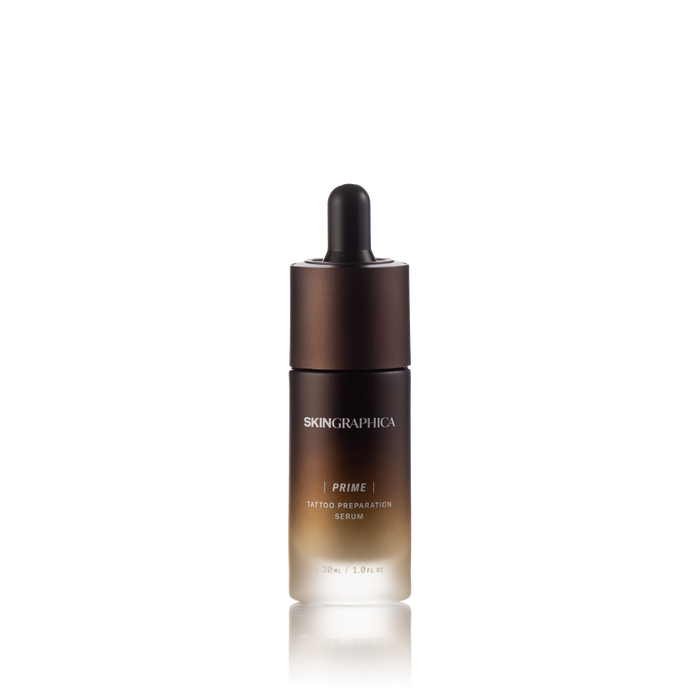
PRIME
Conditions and hydrates the canvas before the needle. Ceramide-rich for cleaner line work and smoother pigment saturation.

LOCK
A breathable recovery complex using Ink-Safe™ biochemistry to stabilise pigment and rebuild the barrier through the critical healing window.

SHIELD
A transparent Fade and Blur Defence Cream. 360-degree shielding against UVA/UVB, HEV blue light, and urban pollutants with zero white cast.
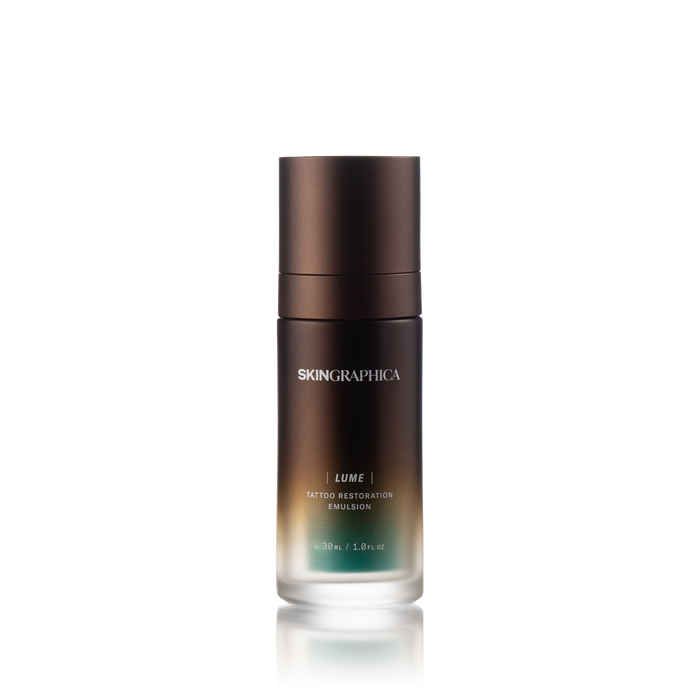
LUME
A world-first restoration emulsion, clinically engineered to revive the look of faded tattoos in as little as 10 days. Restores clarity, depth and dimensional lustre to older ink.


