

Still Life
Why your tattoo only looks like it is standing still.
Consider the tattoo as most people understand it. A design is pushed into the skin, the skin heals over it, and the image stays put for the rest of your life because, well, that is what skin does. It holds things.
This turns out to be almost entirely wrong.
Your tattoo is not held in your skin the way a photograph is held in a frame. It is held the way a baton is held in a relay race. It is carried for a while, dropped, and caught again by the next runner, and this has been happening continuously, every day, since the moment you left the studio. The still image on your arm is the visible record of a process that has never once stopped moving.
Where the ink actually goes
To see why, it helps to know where the ink actually ends up. A tattoo needle does not deposit pigment on the skin. It punctures through the epidermis, the thin outer layer your body sheds and replaces on a roughly monthly basis, and drives the ink into the dermis below. If the ink stayed in the epidermis, every tattoo would wash away within weeks. The dermis is more stable, which is part of the answer, but only part.
The more interesting part is what your body does next. From its point of view, you have just driven thousands of foreign particles into an open wound. The immune system responds exactly as it would to any invader. White blood cells called macrophages, a name that translates roughly as “big eaters”, converge on the site and begin swallowing the pigment. For decades the accepted explanation stopped there. These ink-filled cells were assumed to be effectively permanent, sitting in the dermis like sealed jars, which was why tattoos lasted a lifetime.
The discovery that took it apart
In 2018, a team at the Centre d’Immunologie de Marseille-Luminy in France dismantled that explanation. Macrophages, it turns out, do not live forever. They survive for weeks, sometimes months, and then they die, as nearly every cell in your body eventually does. By the old logic, your tattoo should have begun disappearing the first time those cells expired.
It does not, because of what happens at the moment of death. When an ink-laden macrophage dies, it releases its hoard of pigment back into the surrounding tissue. Almost immediately, a neighbouring macrophage moves in and swallows it again. Capture, release, recapture. The pigment never leaves. It simply changes hands. The researchers described a cycle that runs quietly for the entire life of the tattoo, one cell passing the ink to the next, indefinitely.
To prove it, they ran an experiment that reads almost like a riddle. They took a patch of tattooed skin from one mouse and grafted it onto another. Six weeks later, they checked which cells were holding the ink. Almost all of them belonged to the new host, not the original animal. The tattoo had stayed exactly where it was, unchanged to the eye, while the cells responsible for it had been almost entirely replaced underneath.
The image was identical. The biology beneath it was completely different.
What that actually means
This is the part worth carrying into your next conversation. A tattoo is not a fixed object embedded in you. It is an ongoing event. It is the only piece of art you will ever own that your own body maintains for you, in real time, cell by cell, for as long as you are alive to maintain it. No painting restores itself. No print refreshes its own pigment. Your tattoo does, every day, without instruction.
The same mechanism quietly settles two things people usually treat as separate mysteries. The first is why old tattoos soften and spread. Each handover is very slightly imperfect. A fraction of pigment drifts, a particle settles a hair’s breadth from where it began, and across twenty or thirty years of relay these tiny imprecisions accumulate into the gentle blur of an ageing piece. The crispness does not so much fade as migrate.
The second is why tattoos are so stubborn to remove. The particles are simply too large for a macrophage to carry off and clear through the lymphatic system. The cells are stuck with their cargo, which is exactly why the cycle persists. Laser removal works not by bleaching the ink but by shattering those particles into fragments small enough for the cells to finally do what they wanted to do all along, which is carry the foreign matter away. In a sense, removal does not erase your tattoo. It completes a job your immune system started years earlier and was never able to finish on its own.
The ink that gets away
Not all of it stays put. Research published in 2017, using high-intensity synchrotron imaging, found tattoo pigment accumulated in people’s lymph nodes, carried there over time by the same cellular traffic. Surgeons occasionally encounter lymph nodes stained the exact colour of a patient’s tattoo. It is a useful reminder that the edge of a tattoo is far less fixed than the sharp line on your skin suggests. Roughly a third of the ink introduced during a session does not stay where it was placed at all.
A relationship, not a mark
None of this makes a tattoo less permanent. If anything it makes the permanence more remarkable, because it is permanence achieved through constant motion rather than stillness, the way a river holds its shape while every drop of water in it is replaced. The image you chose is being actively defended by your own biology, handover after handover, a process that asks nothing of you and continues whether you think about it or not.
It does change how you might think about looking after it. The clarity of a tattoo depends on a living, replaceable population of cells doing delicate work just beneath the surface. Anything that stresses that system, sun above all, accelerates the drift and dulls the result. The ink is not inert. The skin holding it is not a passive canvas. Both are alive, and both respond to how they are treated.
A tattoo, properly understood, is less a mark you carry than a relationship you keep.
The Complete System
A clinical, stage-targeted protocol engineered for the lifecycle of your ink.
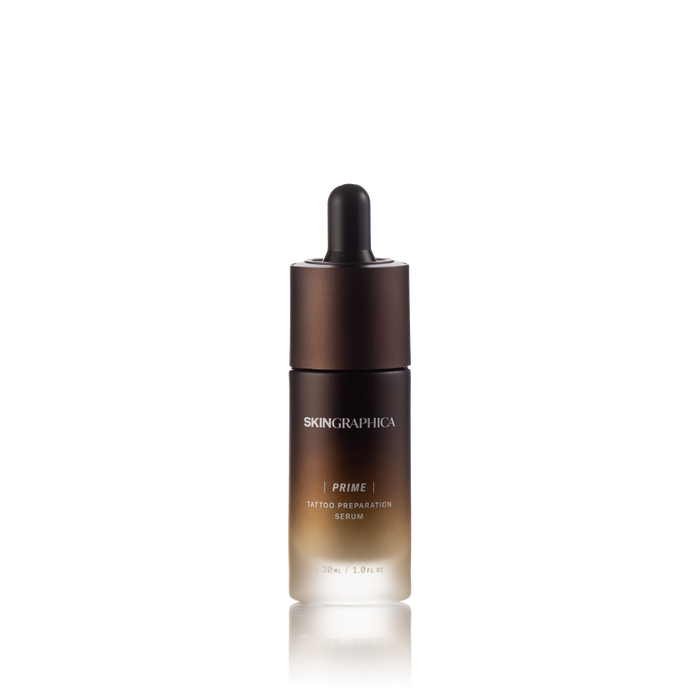
PRIME
Conditions and hydrates the canvas before the needle. Ceramide-rich for cleaner line work and smoother pigment saturation.
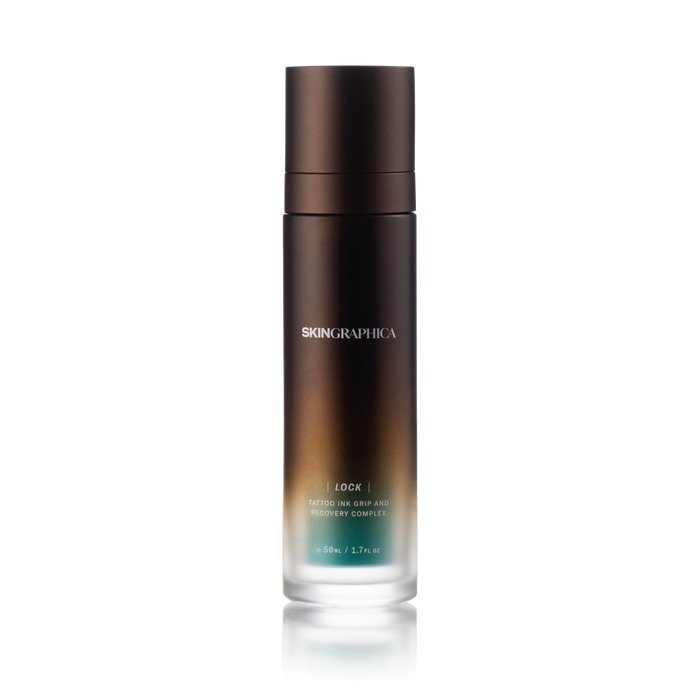
LOCK
A breathable recovery complex using Ink-Safe™ biochemistry to stabilise pigment and rebuild the barrier through the critical healing window.
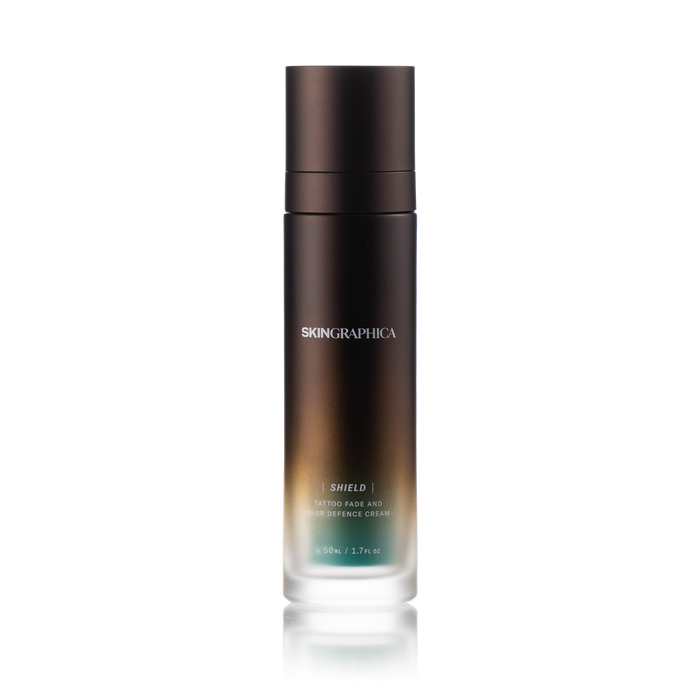
SHIELD
A transparent Fade and Blur Defence Cream. 360-degree shielding against UVA/UVB, HEV blue light, and urban pollutants with zero white cast.
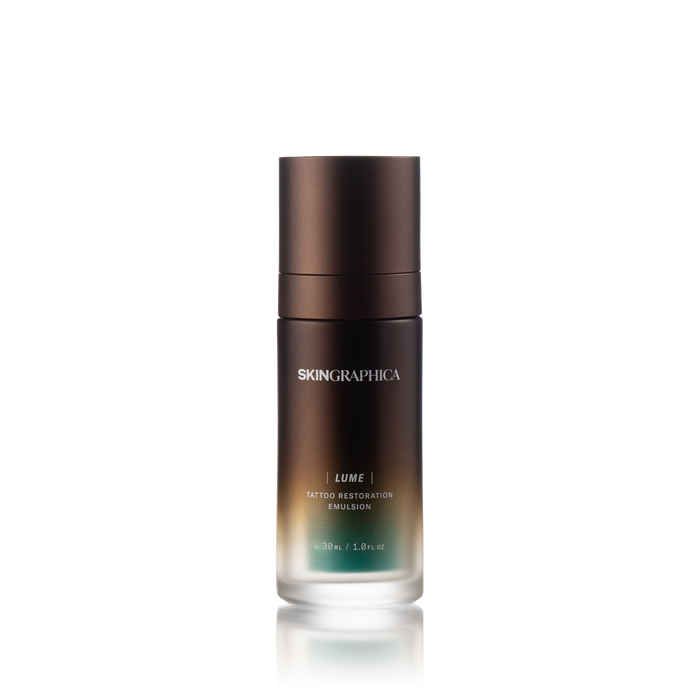
LUME
A world-first restoration emulsion, clinically engineered to revive the look of faded tattoos in as little as 10 days. Restores clarity, depth and dimensional lustre to older ink.


